
Blog · AI
GEO vs. SEO: Differences and Best Practices to Know
Understand what GEO actually changes, how it relates to SEO, and which practices can make content easier to find and cite.
The lines between GEO and SEO are blurring. Search engines are evolving, generative content is taking over, and businesses must adapt to maintain their visibility. If you’ve heard of GEO SEO but aren’t sure what sets it apart, this article explains everything—simply and concretely.
What Exactly Is GEO SEO?
The term GEO SEO combines two concepts: GEO for Generative Engine Optimization and SEO for Search Engine Optimization.
Traditional SEO involves optimizing a website to rank in search results on Google or other classic engines. It relies on well-known criteria: content quality, page structure, backlinks, technical performance, and user experience.
On the other hand, GEO also covers monitoring a brand’s presence in generative answers such as ChatGPT, Perplexity, Gemini, Google AI Overviews, and AI Mode. These answers synthesize multiple sources, with selection varying by platform, query, and context.
In other words, GEO aims to optimize how generative engines understand and cite your content in their responses. It’s a natural evolution of SEO, tailored to an environment where users no longer necessarily click on websites but instead read information presented by an intelligent copilot.
In short:
- The SEO makes content accessible, understandable, and competitive in search.
- The GEO makes content accessible, understandable, and competitive in generative engines.
- Ranking, discovery, and citation overlap; these are not two isolated disciplines.
GEO vs. SEO: What Are the Concrete Differences?
The targeted engines
The SEO focuses on traditional engines like Google, Bing, or Qwant. These engines rank web pages based on well-known optimization criteria: relevance, authority, source reliability, and content quality.
The GEO, however, targets generative engines. These answers synthesize sources from the web or search indexes, with selection varying by platform and context.
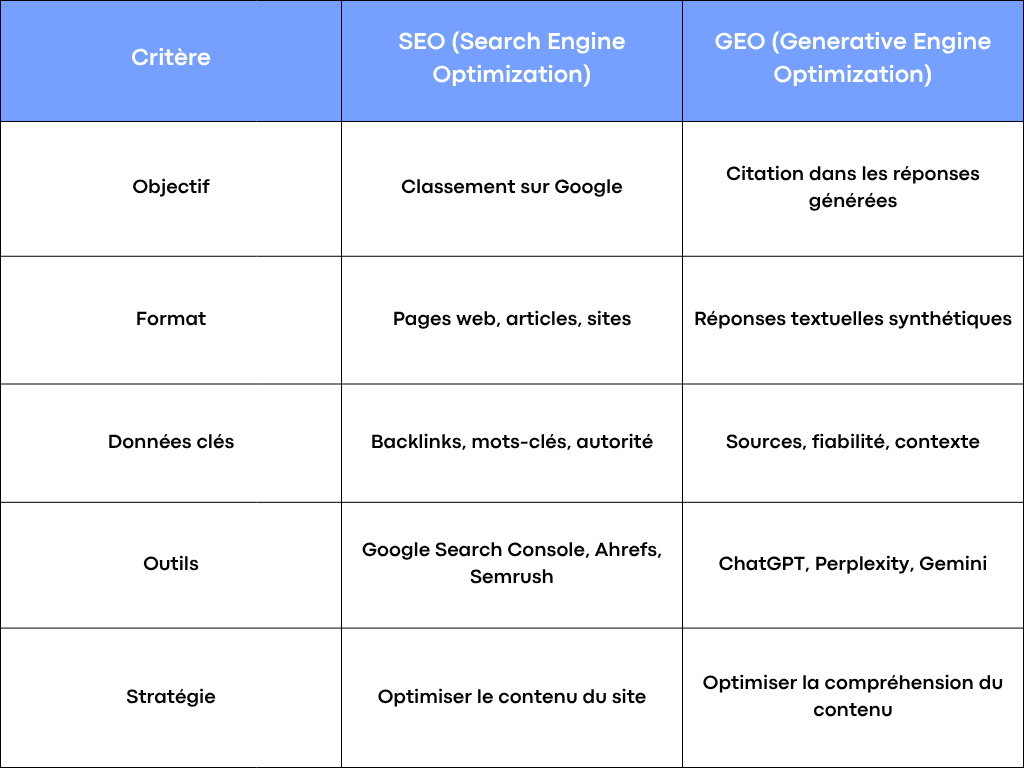
SEO and GEO criteria
These two approaches are not opposed. They complement each other.
SEO remains essential for driving traffic to web pages, while GEO monitoring can reveal potential visibility in the generated responses of generative engines.
How do generative engines choose their sources?
The generative engines like Perplexity or Gemini rely on analysis models that prioritize reliability and clarity. They look for solid, well-structured, and up-to-date sources.
To appear in their responses, your content must meet several optimization criteria:
- A clear structure with consistent headings and subheadings.
- precise information, verifiable and sourced.
- A smooth text and well-structured to aid search engine comprehension.
- A set of verifiable signals—sources, examples, identifiable authors, and consistent facts help readers assess trust.
These engines analyze how your content addresses a query. Confusing or purely promotional copy provides less value. Conversely, educational and balanced content, enriched with data from reliable sources, is more likely to be picked up.
How to optimize content for GEO and SEO simultaneously?
The secret is to think dual optimization: Search Engine Optimization and Generative Engine Optimization.
You need to make your content understandable for both search and generative engines. Here’s how:
Hybrid optimization techniques
- Master your SEO fundamentals:
- Clear structure with logical Hn tags.
- Relevant keywords strategically placed throughout the text.
- Fast, pages that are secure and well-interlinked.
- Clear structure with logical Hn tags.
- Adapt your content to GEO:
- Write explanatory and comprehensive paragraphs.
- Include reliable sources or numerical data.
- Provide clear answers to users’ frequent questions.
- Use an informative tone—neither too technical nor too salesy.
- Write explanatory and comprehensive paragraphs.
- Test your GEO SEO visibility:
- Ask ChatGPT, Gemini, or Perplexity to see if your information appears in generated responses.
- Use classic SEO tools (Ahrefs, Semrush, Google Search Console) to measure your web results.
- Adjust your strategies based on both types of engines.
- Ask ChatGPT, Gemini, or Perplexity to see if your information appears in generated responses.
GEO SEO Best Practices and Mistakes to Avoid
Best practices
- Produce high-quality, clear, and useful content.
- Cite your sources to strengthen perceived reliability.
- Structure information so generative engines can easily understand it.
- Regularly update your pages and data.
- Optimize text readability for both users and engines.
Common mistakes
- Write only for engines, not for users.
- Forget sources and reliability proofs.
- Ignore how generative engines build their responses.
- Neglect content clarity and structure.
- Reuse generated content without refining it for the web.
What GEO SEO strategy should your business adopt?
For businesses, GEO is primarily an extension of SEO and brand monitoring.
Generative and traditional engines coexist. To succeed, you need a hybrid strategy.
- Start with a comprehensive SEO audit: identify the strengths and weaknesses of your web pages.
- Improve the clarity and reliability of your content: structure, source, simplify.
- Monitor your citations in generated responses: test your keywords on ChatGPT, Perplexity, or Gemini.
- Measure results in terms of visibility, traffic, and authority.
A sound strategy measures classic search results, generative citations, traffic, and conversions separately.
GEO and SEO: two complementary levers
GEO and SEO share the same goal: making your content visible, credible, and useful.
The two overlap because generative answers often rely on search systems and their sources.
Publishing genuinely useful and verifiable content improves the chances of being found, read, and possibly cited.
Take action with a GEO SEO strategy
GEO is now part of search marketing monitoring. Current guidance does not require special markup, an ideal length, or systematic AI-specific rewriting.
Today, it is useful to monitor classic results and generative answers without conflating mentions, citations, visits, and conversions.
At Scroll, we combine this monitoring with SEO fundamentals, editorial quality, and outcome measurement through an approach adapted to the context. If you want to adapt your content to new engines, let’s talk.
Frequently asked questions
What is GEO SEO?
The GEO SEO (Generative Engine Optimization) covers practices used to monitor and improve content visibility so that it is understood and cited by generative engines such as ChatGPT, Gemini, Perplexity or Google AI Overviews. It complements SEO.
What is the difference between GEO and SEO?
The SEO works to make a website visible in search results of Google. GEO works to monitor content mentions and citations in the generated responses by generative engines.
Why is GEO SEO becoming important?
Because users are increasingly turning to generative engines to get quick answers. Monitoring these environments is becoming useful for businesses.
How can you optimise your content for GEO SEO?
You need to create clear, sourced and structured texts, directly answering the user queries, and use SEO tools and GEO such as Google Search Console, Perplexity or Gemini.
Does GEO SEO replace traditional SEO?
No. GEO SEO complements SEO. Both strategies can be monitored together, without guaranteeing lasting visibility on the web and in generative engines.