Blog · AI
pgvector or Qdrant: Which vector database for your RAG?
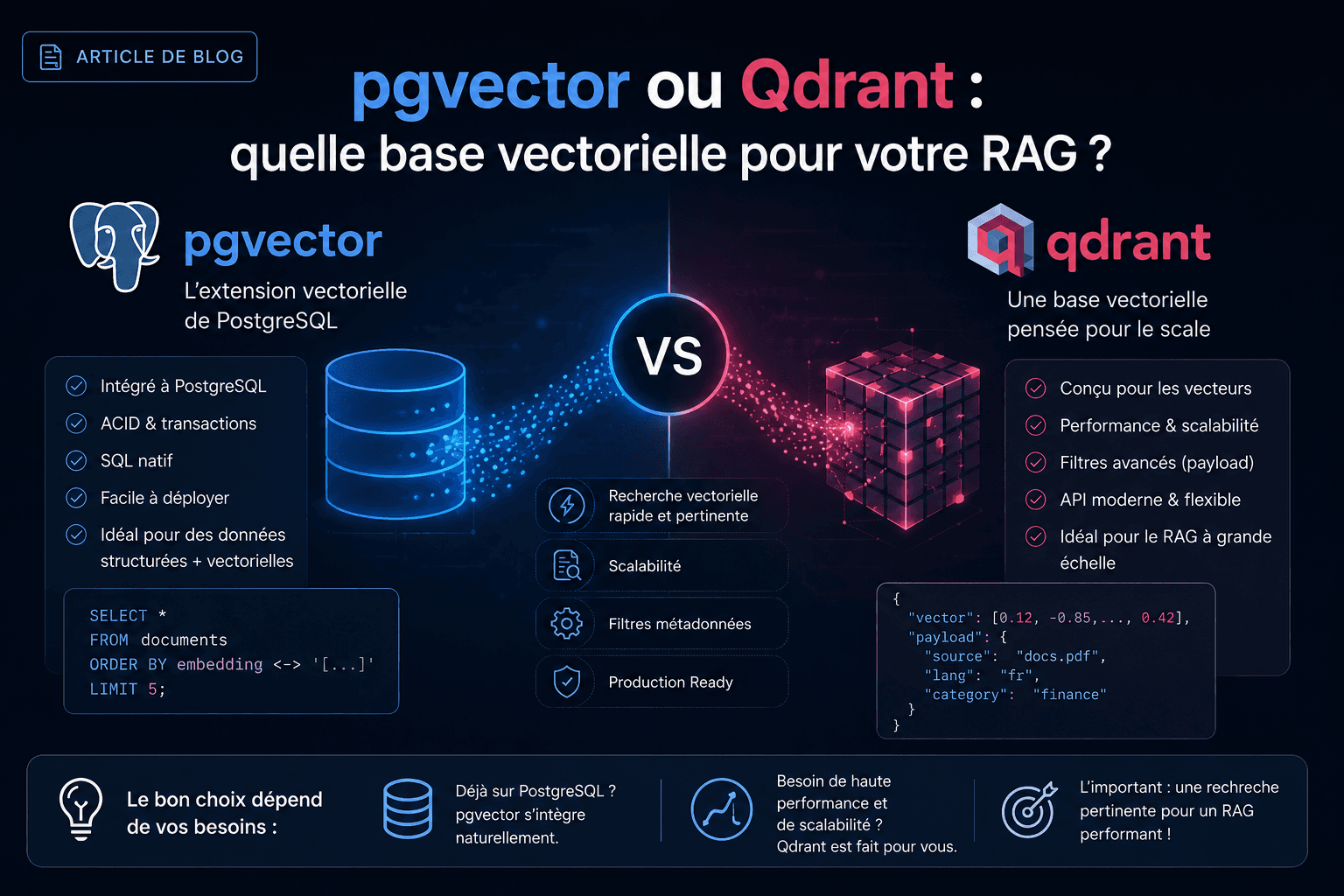
pgvector stores your embeddings in PostgreSQL, while Qdrant is a dedicated vector database. When one suffices, and when the other is essential.
A RAG or semantic search project stores embeddings — vectors — and finds those closest to a query. Two options stand out: pgvector, a PostgreSQL extension, and Qdrant, a dedicated vector database. The right choice depends on your data volume and stack.
pgvector: a single database for everything
pgvector adds vector type and similarity search directly to PostgreSQL. Your embeddings live alongside your business data, in the same database — often Supabase.
- A single database to manage, back up, and secure.
- Your vectors and relational data intersect in a single SQL query.
- Hostable in Europe or self-hosted, just like the rest of your PostgreSQL.
For the vast majority of projects — from a few hundred thousand to a few million vectors — pgvector is more than sufficient. It’s our default choice, as detailed on our Agence Supabase page.
Qdrant: the dedicated database for very large volumes
Qdrant is designed solely for vectors. At very large scale (tens of millions of vectors, critical latency, complex metadata filtering), a dedicated database handles the load better and offers advanced filtering and quantization features. The trade-off: an additional component to manage alongside your PostgreSQL.
How to choose
- pgvector if your volume is manageable and you want a simple stack — which covers most business cases.
- Qdrant (or a dedicated alternative) if you're targeting very high volume, tight latency, or advanced filtering.
In both cases, the real challenge remains the RAG architecture: chunking, embedding quality, and result filtering. We cover this in our article on RAG in enterprise, and it’s at the core of our AI assistants connected to your data.
A semantic search project to scale? We’ll help you pick the right database.