Blog · AI
RAG (Retrieval-Augmented Generation): What Use Cases?
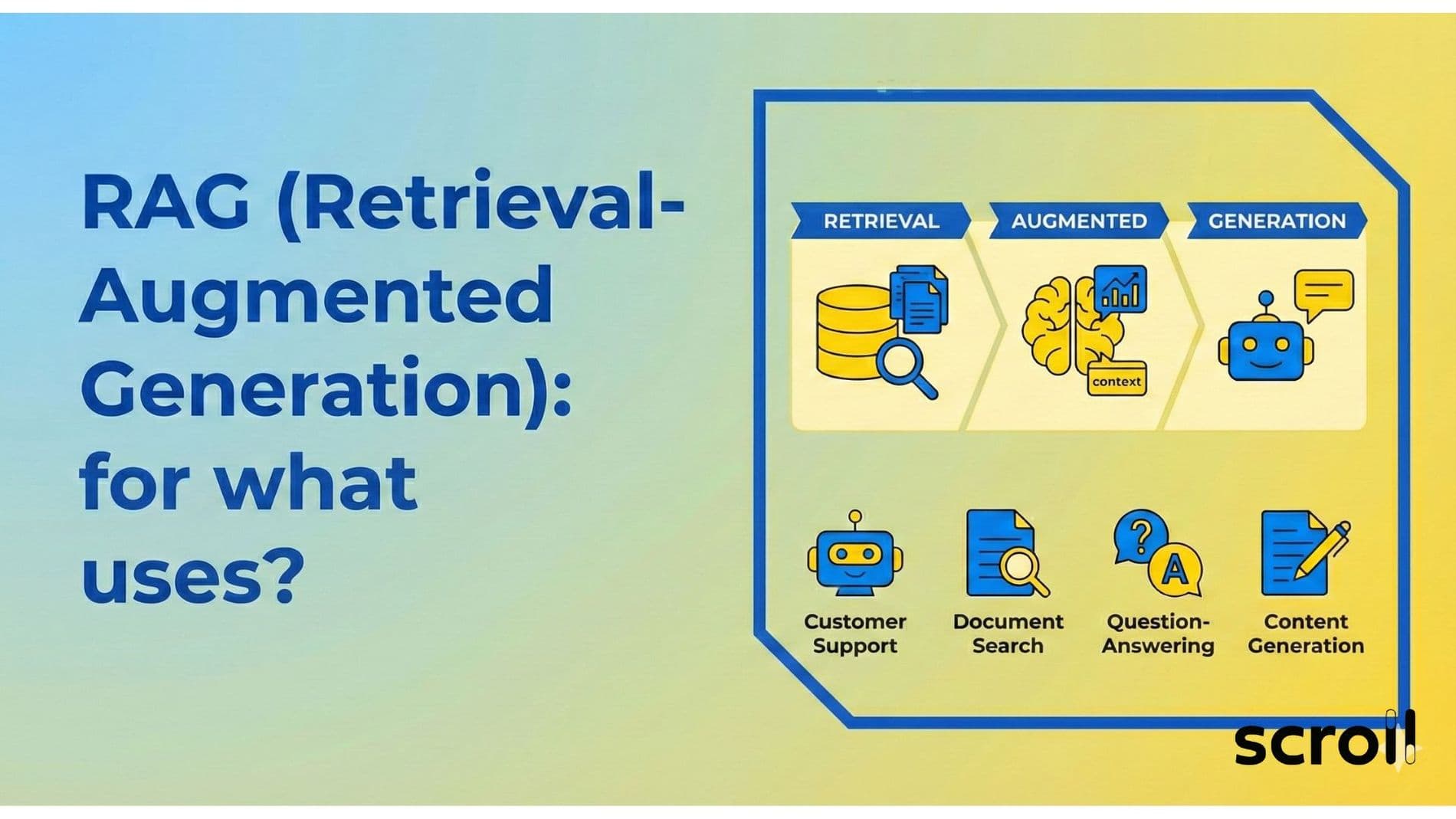
What is RAG? Discover how to make AI more reliable with your own data. 5 concrete use cases to boost your company's productivity.
Current language models have encyclopedic knowledge of the public world, but they know nothing about your business. This is the paradox of modern AI. You have access to the most powerful tool of the decade, yet it can't tell you your employees' remaining vacation days or the technical specifics of your latest product. To turn artificial intelligence into a real growth driver, it is essential to connect these models to your own data via RAG, or retrieval-augmented generation.
What is RAG (Retrieval-Augmented Generation)?
The Retrieval-Augmented Generation, often referred to as RAG, is a technical architecture that enhances the results of a large language model (LLM) by giving it access to an external knowledge base before generating a response. It’s the missing bridge between AI’s linguistic power and your business’s operational reality.
Imagine an open-book exam. A standard LLM, like GPT or Claude, takes the test using only what it learned during its initial training. If it doesn’t know the answer, it may confidently invent facts to meet the request. This is known as hallucination. With a RAG architecture, the AI is allowed to look up information in a reliable reference manual—your data—before writing its answer.
This approach addresses the two major limitations of traditional natural language processing. First, it solves the issue of data obsolescence, as the model is not frozen in time. Second, it provides the missing private context. By connecting the generative AI to your external data, you turn a generalist tool into an expert in your field.
5 Enterprise Use Cases Where RAG Is Indispensable
Adopting RAG isn’t just about technological innovation—it’s a concrete answer to business needs for productivity and reliability. Here are the areas where this technology excels and transforms operations.
Intelligent Chatbots and Augmented Customer Support
Customer service has long been the testing ground for automation attempts, often with disappointing results in the past. Integrating intelligent chatbots powered by RAG changes the game entirely. Unlike traditional bots based on rigid decision trees that frustrate customers, a RAG assistant understands user intent and draws from technical documentation, ticket history, and product knowledge bases to craft its response.
The precision of responses is the key factor here. The system doesn’t just redirect users to a generic FAQ page. It synthesizes the exact solution to the customer’s problem in real time. This significantly enhances the user experience while freeing up support teams from level-1 inquiries. Additionally, AI response optimization allows the tone and complexity of the response to be tailored to the user’s profile, whether they’re a novice or a technical expert.
Leveraging Enterprise Documentation
Most of a company’s knowledge sits in inaccessible silos like PDFs, intranets, SharePoints, or Notion accounts. Traditional keyword searches in these environments are often ineffective because they require employees to know the exact term in the document. RAG enables exploitation of internal data in natural language.
Now, an employee can ask a complex question like, "What is the approval process for expense reports for travel outside the EU with a VIP client?" and receive a synthesized answer. This ability to interact with enterprise documentation generates productivity gainsmassive. We shift from a time-consuming document search logic to a targeted, immediate information retrieval approach.
Decision Support and Legal Analysis
In highly regulated sectors like law, finance, or insurance, even the smallest mistake can be costly. The reliability of responses is non-negotiable. Using RAG ensures a strong factual grounding. When a legal expert queries a contract database via a RAG architecture, the model generates its response by explicitly citing the clauses and articles it relies on.
This traceability enables rapid human verification and builds the necessary trust in hybrid AI systems. The tool doesn’t replace the expert—it enhances their analytical capabilities by processing data volumes that a human couldn’t absorb in a reasonable time. It’s an tireless research assistant that pre-processes the analysis work.
Employee Onboarding and Training
Integrating new talent is a time-consuming process for managers and HR. A RAG-based virtual assistant can serve as a 24/7 mentor for new hires, answering questions about company culture, internal processes, or professional tools based on reliable information sources validated by HR.
This ensures the information provided is always up to date, unlike static onboarding booklets that become obsolete as soon as they’re printed. knowledge updates are as simple as adding new internal policy documents to the vector database, with no need for complex retraining or heavy technical intervention.
Augmented Search Engines for E-commerce
The augmented search engines represent the future of navigation on complex e-commerce sites or large B2B catalogs. Instead of filtering by categories, users can express a functional need: "I’m looking for a storage solution compatible with my model X server that optimizes energy consumption."
The system uses semantic search to understand technical features and product compatibility, delivering relevant recommendations that go beyond simple keyword matching. This is a direct application of data vectorization to improve conversion and guide the customer toward the right product seamlessly.
Why choose RAG architecture over Fine-Tuning?
It’s a recurring question among technical decision-makers: should you retrain a model (Fine-Tuning) or use RAG? While the comparison between RAG vs LLM and fine-tuned models deserves nuance, RAG comes out on top in the vast majority of business applications for pragmatic and economic reasons.
The first reason is financial. The costs of training LLMs to teach them new knowledge are prohibitive and must be repeated with every significant data change. With RAG, real-time data integration is possible. Simply index the new document, and it’s immediately "known" by the system. This offers agility that Fine-Tuning cannot match.
The second reason concerns accuracy. Fine-Tuning is effective for teaching the model a style, industry-specific vocabulary, or response format, but it remains prone to factual hallucinations. The model "thinks" it knows, but it can be wrong. RAG excels in reducing hallucinations because it constrains the model to respond only based on the context provided by the retrieval systems. If the information isn’t in the retrieved documents, the model is programmed to say "I don’t know," rather than inventing a plausible but false answer.
Finally, the comparison between RAG vs generative AI highlights transparency. RAG allows you to source every generated sentence, providing auditability impossible with a "black box" model that simply memorized information during training. You know exactly why the AI gave that answer.
Technical Workflow: From Raw Data to Generated Response
To understand RAG’s power, you need to lift the hood and examine the data flow. This process transforms inert documentation into active intelligence through several critical steps that require expertise in data engineering.
Data Ingestion and Preprocessing
It all starts with collecting documents from various sources. The data preprocessing is an often underestimated yet vital step for final performance. This involves cleaning the texts, removing noise (unnecessary headers, footers, HTML tags) and splitting the information into digestible pieces called "chunks". The quality of this segmentation directly impacts the relevance of future results. If the chunks are too short, the necessary context for understanding is lost. If they are too long, precise information gets buried in noise.
Vectorization and Vector Databases
Once the text is split, it goes through a data vectorization (or embedding) step. Specialized models transform these text snippets into mathematical vectors—long sequences of numbers that represent the semantic meaning of the content in a multidimensional space. These vectors are stored in vector databases such as Pinecone, Weaviate, Qdrant, or Milvus. These databases are specifically designed to perform ultra-fast similarity searches, far more efficient than traditional SQL databases for this type of task.
The Retrieval Mechanism
When a user asks a question, it is also vectorized in real time by the same embedding model. The system then performs a semantic search in the vector database to identify the text "chunks" whose vectors are mathematically closest to the question. This is where the magic of information retrieval happens: the system doesn’t look for the same keywords, but the same meaning or intent.
Augmented Generation
The most relevant text snippets are extracted and sent to the LLM (such as GPT or Claude) along with the user’s question, within a structured instruction called a "prompt". The language model then acts as an intelligent synthesis processor: it reads the provided context and crafts a smooth, coherent, and well-reasoned response. This combination is what defines AI response optimization through RAG.
Security Challenges and Current Limitations
While RAG is powerful, its implementation demands absolute rigor, particularly regarding data security. One common pitfall is access rights management. If your vector database contains all company documents without distinction, an intern should not be able to ask the chatbot "How much does the CEO earn?" and receive an answer extracted from a confidential payroll file that was mistakenly indexed.
Access rights management at the information retrieval is therefore critical to ensure GDPR compliance and industrial confidentiality. The system must be able to filter documents accessible to the user before even sending them to the LLM for generation. This requires synchronizing the security metadata of your original documents with the vector database.
Another major challenge lies in the quality of the source data. The principle "Garbage In, Garbage Out" fully applies here. If your corporate documentation is contradictory, outdated, or poorly structured, RAG will produce inconsistent answers, regardless of the underlying model's power. A data governance strategy is often the essential prerequisite. The success of a RAG project often depends 80% on data engineering and 20% on the AI itself.
Turn your data into active intelligence
The retrieval augmented generation is no longer an experimental technology reserved for research labs. It is the industrial standard for deploying useful, reliable, and secure generative AI in businesses. It enables you to leverage your data assets by making them instantly accessible and actionable for all your employees.
At Scroll, we don’t just implement isolated technical components. We design the complete architecture, from the initial audit of your data to the production deployment of robust and secure hybrid AI systems. If you want to transform your inert document bases into true performance drivers, we can define your first application scope together.
Would you like a concrete demonstration of what RAG can do with your own data? Contact the Scroll team to schedule a preliminary audit and uncover the hidden potential of your information.
To put this into practice, we help you deploy a RAG in your company.
Frequently asked questions
What is RAG (Retrieval-Augmented Generation) in artificial intelligence?
The RAG (or retrieval-augmented generation) is an architecture that combines the power of a LLM (such as GPT) with an external knowledge base. Unlike traditional AI, which relies solely on its training data, RAG retrieves up-to-date information from your internal data before generating a response, ensuring relevance and context.
What is the difference between RAG and Fine-Tuning?
Fine-Tuning involves retraining a model to teach it new knowledge, which incurs high LLM training costs and lacks flexibility when changes occur. RAG on the other hand, connects the model to a dynamic database. It is ideal for frequent knowledge updates and for factual grounding, as it does not require retraining to absorb new information.
How does RAG reduce AI hallucinations?
Language models can fabricate facts when they lack information. The RAG architecture drastically reduces this risk by forcing the AI to use only the reliable information sources retrieved during the search. If the information is not found in the vector database, the system is configured to state that it does not know the answer, thus ensuring the reliability of responses maximum.
Does RAG guarantee the security of corporate data?
Yes, if the architecture is well designed. Unlike public models where your data may be used for training, a private RAG system allows you to retain full control. You can manage access rights at the information retrieval level (a user only sees what they are permitted to see) and ensure GDPR compliance by hosting data on secure servers or via private instances.
What types of data can be leveraged with RAG?
RAG is extremely flexible thanks to data vectorization. It enables the exploitation of internal data in almost all textual formats: technical PDFs, legal contracts, Intranet pages, support tickets, emails, or SQL databases. Once processed by the retrieval systems, this unstructured data becomes a knowledge source that can be queried in natural language.