Blog · AI
AI Agent: Definition and How to Create One?

Want to automate your business? Discover the definition of an AI Agent and learn how to create your own step by step with this practical guide.
Understanding the exact definition of an AI agent and knowing how to create one has become a major strategic issue for boosting the productivity of any business. This guide details how these systems work and provides the precise steps to deploy your own virtual assistant.
How to Create an AI Agent? Steps and Platforms
The theory is fascinating, but practice is even more so. When looking to integrate artificial intelligence into your business, the first question that arises concerns the creation method. Building an AI agent requires a clear understanding of the business processes you want to delegate. While the technology has become widely accessible, deploying a truly autonomous and reliable tool requires rigor and often precise technical support to avoid design mistakes.
The Best Tools and Platforms (No-Code and Open-Source)
The market now offers a multitude of solutions for designing these systems. The choice of tool will depend directly on your ambitions, budget, and the complexity of the tasks to be accomplished. It’s entirely possible to prototype an idea with a free tool before moving on to a custom solution.
- No-code platforms represent an excellent entry point. Tools like Bubble, Make or Zapier now integrate artificial intelligence modules. These platforms allow you to create an AI agent using a visual interface by connecting logical blocks. This is ideal for testing a concept or automating simple tasks without writing code. However, these solutions quickly show their limits when it comes to handling complex scenarios or processing sensitive data.
- Turnkey solutions like OpenAI with its custom GPTs offer the ability to configure an assistant in just a few minutes. You can provide instructions, upload reference documents, and get a functional agent very quickly. This is an interesting approach for basic internal use, but it often lacks the flexibility needed for deep integration into a company’s information system.
- Open-source frameworks are the royal road for serious projects. Libraries like LangChain or LlamaIndex provide the essential building blocks for creating a custom architecture. Open-source allows developers to control every aspect of the AI’s operation, from memory management to the integration of specific tools. This is the approach we favor at Scroll to ensure our clients retain full intellectual property and maximum security.
Architecture and Workflow for Deploying an Autonomous Agent
Creating an AI agent is not just about writing a complex prompt. It’s a full-fledged software development project that requires a solid architecture. For an agent to be truly autonomous, it must be able to perceive its environment, think about the best action to take, and execute that action. Here are the fundamental steps to deploy such a solution.
- Define the automation workflow. This involves mapping out with surgical precision the process the agent will need to execute. What are the triggers? What are the success conditions? What exceptions need to be handled? A poorly defined workflow will inevitably lead to unpredictable behavior from the AI.
- Connect external tools. An isolated AI agent isn’t very useful. For it to take action, it needs access to your tools via APIs. This could be your invoicing software, email inbox, or customer database. This is where web development work comes into its own, as these connections must be robust and secure.
- Structure memory. For a conversation or task to flow smoothly, the agent must remember the context. We implement short-term memory for the current session and long-term memory—often based on vector databases—to leverage past interactions and personalize the experience.
- Configure the reasoning engine. This is the agent’s core. We use powerful language models combined with advanced techniques like prompt engineering. The agent must be able to break down complex requests into simple subtasks, evaluate the results of its actions, and correct its mistakes.
- Test and deploy in a real-world environment. Deployment doesn’t mark the end of the project but the start of a learning phase. It’s crucial to monitor the agent’s actions, analyze its failures, and continuously optimize its settings to maximize productivity.
What is an AI agent? Definition and how it works
Now that we’ve covered the creation process, it’s essential to clearly define our subject. The term *artificial intelligence* is often misused. To fully harness this technology’s potential, you need to understand what sets a simple algorithm apart from a true agent capable of acting on your behalf.
The difference between a chatbot and an autonomous assistant
The confusion is common, but the distinction is fundamental to grasping the value these new technologies bring.
The classic definition of a chatbot is a computer program designed to simulate conversation. Historically based on rigid decision trees, chatbots evolved with the advent of generative AI. Today, a modern chatbot can understand natural language and generate relevant responses. However, its operation remains passive. It waits for a question, retrieves information from its knowledge base or generates text, then stops. It’s a conversational partner, but not an actor.
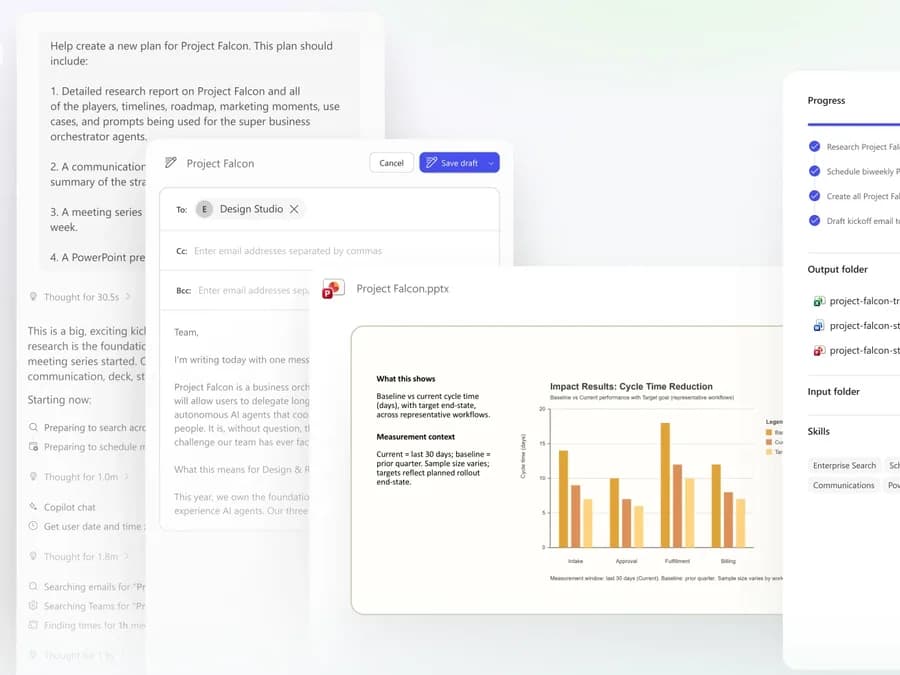
In contrast, an AI agent is a system with the ability to take action. An autonomous assistant doesn’t just tell you *how* to do something—it does it for you. If you ask a chatbot to organize a meeting, it will give you time management advice. If you ask an AI agent the same thing, it will check participants’ calendars, find a common slot, send email invitations, and create the video conference link autonomously. The added value lies in this ability to reason and execute in the real world, which radically transforms how a business operates.
The different types and multi-agent systems
Not all AI agents are designed for the same missions. Your solution’s architecture will depend on the intended use case. There are several major categories that help structure AI projects in businesses.
- Research and analysis agents specialize in processing large volumes of information. They can scour the web, analyze hundreds of internal documents, synthesize financial reports, or conduct competitive intelligence. Their goal is to provide qualified, actionable information for executive teams.
- Task execution agents are action-oriented. They interact with your business software. For example, they can extract data from an invoice received by email, verify the accuracy of amounts, and input the information directly into your accounting software—all without human intervention.
- The multi-agent approach represents the cutting edge of this technology. In these complex systems, multiple specialized AI agents work together. Imagine a virtual team where one agent handles information research, another writes content, and a third proofreads and publishes. They communicate, correct each other, and collaborate to achieve a common goal. This method solves highly complex problems while minimizing errors, as each agent oversees the others’ work.
Use cases and ROI of automation in business
Integrating an AI agent shouldn’t be just a technological showcase. It must address specific challenges and deliver tangible return on investment. ROI is measured in time savings, reduced human errors, increased revenue, and improved customer satisfaction.
Optimize customer relations and prospecting
The customer service field is particularly well-suited for deploying these technologies. A well-configured AI agent can transform customer relations. Imagine a system capable of handling incoming requests 24/7. The agent receives a message from a dissatisfied customer about a delivery delay. It analyzes the tone, connects to the logistics system to check the package status, crafts an empathetic and personalized response, offers a discount voucher proportional to the inconvenience, and updates the ticket in the CRM—all in seconds. Human teams are freed from repetitive tasks and can focus on complex disputes requiring genuine emotional intelligence.
Sales prospecting is another use case where ROI is immediately measurable. Finding new clients is a time-consuming activity that often exhausts sales teams. An AI agent can take over the top of the conversion funnel. It can scan professional networks to identify profiles matching your target audience, analyze their companies’ news to find relevant talking points, and draft highly personalized outreach emails. The agent manages follow-ups intelligently, respecting the prospect’s pace. When a positive response is detected, it hands the conversation off to a human salesperson, who receives a complete file and clear context. The business thus multiplies its sales reach without proportionally increasing its workforce.
Anticipate technological risks and ensure compliance
The enthusiasm generated by artificial intelligence’s capabilities must not overshadow the responsibilities of the businesses deploying it. Entrusting decision-making and actions to an autonomous system involves risks that must be anticipated from the design phase.
The first risk concerns data confidentiality and security. An AI agent that handles your customer database information or accesses your financial documents becomes a prime target for cyberattacks. It’s essential to ensure the technical architecture is airtight, that data flows are encrypted, and that the language models used do not retain your sensitive data for training. Free solutions or public platforms generally do not provide the necessary guarantees for enterprise use.
Managing hallucinations is another major technical challenge. AI models can sometimes generate false information with unsettling confidence. If an autonomous agent makes a business decision based on fabricated data, the consequences can be disastrous. Therefore, strict safeguards must be integrated into the reasoning engine, source verification must be enforced, and a human validation system must be maintained for critical actions.
Finally, regulatory compliance is unavoidable. The European Union strictly governs the deployment of these technologies through the AI Act. This regulation imposes transparency, security, and traceability obligations, proportional to the level of risk posed by the system. An AI agent used for recruitment or credit assessment will be subject to very strict rules. Deploying a solution without considering AI Act compliance exposes the company to severe financial penalties and significant reputational risk.
Creating and integrating an AI agent cannot be improvised. While tools are multiplying, the success of such a project relies on cross-functional technical expertise combining web development, data engineering, and cybersecurity. Professional support turns a simple experiment into a sustainable competitive advantage, while managing the inherent risks of these new technologies. This is precisely the mission of our agency, Scroll. We design and integrate custom artificial intelligence solutions, seamlessly integrated into your existing ecosystems, allowing you to focus on what truly matters: growing your business. A well-executed project is one where technology fades into the background, leaving only the results. Feel free to request our expertise to audit your processes and identify together the most profitable automation levers for your business. Which internal process would you like to optimize as a priority?
Frequently asked questions
What is the exact difference between an AI Agent and a chatbot?
A traditional chatbot is simply a program that generates text to simulate a conversation. In contrast, an AI agent is a fully autonomous assistant capable of reasoning, designing complete workflows, and executing concrete actions directly within your software. It doesn’t just passively chat—it takes action to significantly boost your company’s productivity.
Do you need development skills to create an AI agent?
It’s entirely possible to use no-code platforms to build a simple prototype, sometimes even with free access. However, to create a reliable tool and deeply integrate it into your information system, these solutions quickly reach their limits. For a robust and secure architecture, leveraging open-source frameworks with professional expertise remains the most dependable and sustainable approach.
How does the reasoning process work for these different types of assistants?
These tools operate through a combination of a powerful reasoning engine and advanced data management. Different types of agents rely on short-term memory to analyse the immediate context of a request, paired with long-term memory to retain critical information from past interactions. This mechanism ensures precise and highly personalised responses.