Blog · AI
What is an AI assistant? The 6 best examples

Discover what an AI assistant is and explore 6 concrete use cases to automate your tasks and boost productivity. Comprehensive guide and tools.
AI assistants are no longer a tech curiosity. Today, they save users hours every week—when used effectively. But there’s a gap between the hype and reality. This article provides a clear definition of what an AI assistant is, then reviews six use cases that demonstrate what you can truly achieve with them today, whether you're a freelancer, marketing manager, or business leader.
What is an AI assistant?
An AI assistant is software that leverages artificial intelligence to understand your requests in natural language and respond in a relevant way. Unlike traditional chatbots that follow rigid scripts, an AI assistant uses natural language processing (NLP) and generative AI to interpret the context of your query and produce a tailored response. It doesn’t pull from a pre-written database. Instead, it generates answers in real time using the AI models it’s built on, such as GPT (OpenAI), Gemini (Google), Claude (Anthropic), Mistral, or Llama (Meta).
There are three distinct levels. Classic chatbots recognize keywords and return predefined answers—useful for simple FAQs but quickly limited when queries go off-script. AI assistants understand the meaning of your sentences, generate content, and adapt to context. This is the level of ChatGPT, Google Gemini, or Claude AI when used in conversation. AI agents go even further: they autonomously chain multiple actions, cross-reference your internal data, make decisions, and execute tasks without human intervention. This is the current frontier of AI applied to productivity.
The power of a virtual assistant depends on the AI model running it, but also on its tool integrations. An assistant connected to your CRM, email, and internal knowledge base becomes a true productivity tool. An assistant isolated in a chat window remains a sophisticated gadget. It’s the tool integrations that transform a conversational assistant into a measurable productivity lever.
6 examples of what you can do with an AI assistant
1. Automate customer service
This is the most mature AI use case. A conversational assistant connected to your knowledge base can answer your customers’ most frequent questions 24/7, with no wait time. We’re no longer talking about dropdown-menu chatbots that frustrated everyone. Thanks to natural language processing, the AI assistant understands the question even when it’s poorly phrased and provides a precise answer based on your content.
In practice, a well-configured virtual assistant handles 60 to 80% of first-level requests. It manages questions about opening hours, delivery terms, returns, order tracking, or standard procedures. When it can’t answer, it transfers the conversation to a human with full context. Your support teams focus on complex cases, and your customers get a response in seconds instead of hours. Tools like ChatGPT via API, Claude AI, or no-code AI platforms such as Botpress and Voiceflow allow you to deploy this type of assistant without writing a single line of code.
2. Generate and optimize marketing content
Content production is a time sink for most marketing teams. Writing blog articles, campaign emails, social media posts, sales pages, or video scripts: an AI assistant speeds up every step of the process. You give it a brief, a tone of voice, and a format, and it delivers a usable first draft in seconds.
This isn’t about blindly copying raw AI output. The value lies in using it as an accelerator. You start with the assistant’s draft, refine it, and add your expertise and real-world examples. The productivity gain is tangible: what used to take two hours of writing now takes thirty minutes of review and adjustment. ChatGPT, Google Gemini, or specialized platforms like Jasper AI are designed for these AI use cases. And when you combine generative AI with an SEO tool, you can also optimize your content for search rankings in the same workflow.
3. Qualify and follow up with leads
In B2B sales, a significant portion of salespeople’s time is consumed by repetitive tasks: enriching prospect profiles, drafting outreach emails, following up with silent contacts, and qualifying incoming leads. An AI assistant connected to your CRM can handle all of this—or at least the bulk of it.
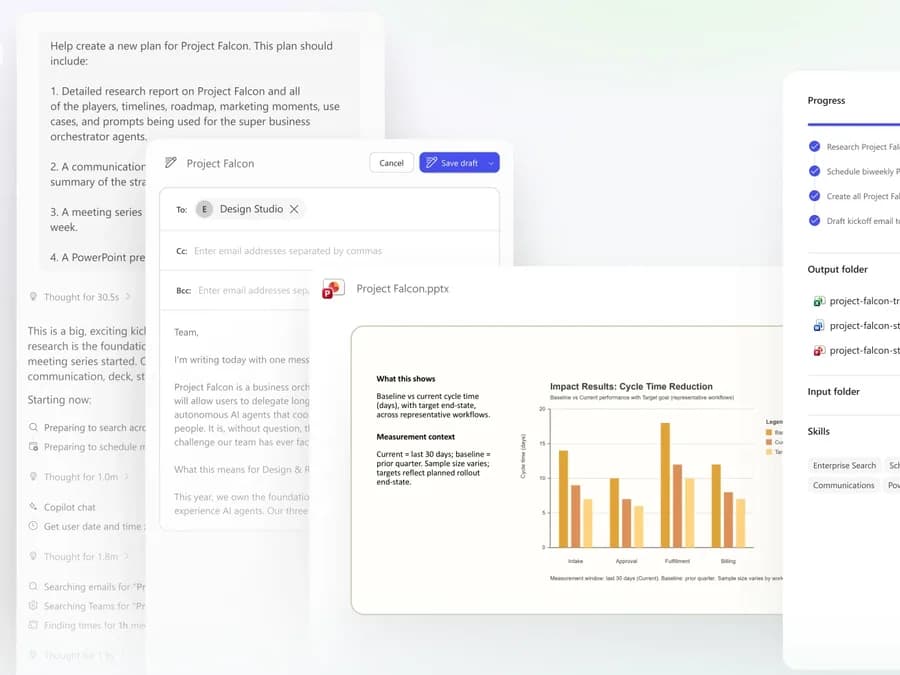
Here’s how sales task automation works in practice. A lead fills out a form on your website. The AI assistant enriches their profile with public data: job title, company, size, industry. It evaluates the lead against your qualification criteria. If qualified, the assistant drafts a personalized outreach email and sends it automatically. If there’s no response within five days, it schedules a tailored follow-up. All of this without any human intervention. Microsoft Copilot handles part of this natively within the Office ecosystem. To go further, integration platforms like'Make or n8n' allow you to build custom AI prospecting agents connected to your CRM and email sequences.
4. Analyze documents and data
Reading an 80-page contract, summarizing a financial report, or cross-referencing data from multiple Excel files: these tasks take hours when done manually. An AI assistant like Claude AI, with its 200,000-token context window, can ingest an entire document and deliver a structured summary in seconds.
This AI use case is particularly powerful in legal, finance, compliance, and HR. Upload a contract and ask the assistant to list risky clauses. Submit three supplier quotes and it will prepare a comparison table. Provide a raw dataset and it will identify key trends. The strength of natural language processing is that you ask your question in plain language, without formulas or complex queries, and the AI assistant does the work. Data confidentiality is obviously critical here. Opt for enterprise versions of ChatGPT, Claude AI, or Microsoft Copilot, which ensure your data isn’t used to train AI models and offer contractual commitments regarding data security.
5. Support HR teams and onboarding
Human resources is a fertile ground for enterprise AI assistants. An internal virtual assistant can answer employees’ recurring questions: vacation balance, expense report procedures, remote work policies, or access to internal tools. Instead of contacting HR for every daily question, employees query the AI assistant, which draws from the company’s documentation to provide reliable, up-to-date answers.
Onboarding new hires is another high-impact AI use case. An AI assistant can guide each new employee step by step through their first weeks: company introduction, tool setup, key contact lists, training schedules, and answers to questions they might not dare ask their manager. All of this without requiring constant human involvement. This type of assistant can be built using low-code AI platforms like Botpress or Voiceflow, connected to your HR knowledge base via tool integrations.
6. Building autonomous AI agents for end-to-end workflows
The most advanced use case is autonomous AI assistants, also known as AI agents. Here, we’re no longer talking about an assistant that answers a question. We’re talking about a system that handles an entire workflow from start to finish, with no human intervention between triggering and delivering the result.
Let’s take an example. You want a competitive intelligence report on three companies every Monday morning. An AI agent can automatically search for the latest news on each competitor, compile available financial data, analyze hiring trends, cross-reference everything with your internal notes, structure a clear report, and send it to you via email or Slack. All without any action on your part between the initial setup and receiving the deliverable.
This level of task automation relies on orchestrating multiple AI models, data sources, and connected tools. No-code AI and low-code AI platforms like Make, n8n, and Relevance AI allow you to build these AI agents without coding. However, the design complexity increases: you need to anticipate error cases, manage data security, and ensure the reliability of results over time. This is often where a specialized AI agent agency makes the difference between a fragile prototype and a robust production system.
How to create your own AI assistant
Creating AI assistants has become accessible thanks to no-code AI and low-code AI. Platforms like Botpress, Voiceflow, Stack AI, n8n, and Make let you design a functional virtual assistant using a visual interface. You select the AI model (GPT, Claude, Mistral), connect your data sources, define the assistant’s behavior, and deploy it on your preferred channel: website, Slack, WhatsApp, or internal app.
The proven process has six steps. First, precisely define the AI use case: “I want an AI assistant” isn’t a brief, but “I want an AI assistant that answers customer questions about our delivery terms using our FAQ” is. Next, choose the AI model that fits the need. A powerful model like GPT isn’t always necessary—lighter models can be faster and more cost-effective for simple tasks. Then, connect data sources and ensure tool integration, often the most technical phase even in no-code AI. Next comes conversational flow design: how the assistant responds when it doesn’t understand, lacks an answer, or the user is frustrated. After that, test and iterate with real users. Finally, monitor performance and data security once the assistant is in production.
Prototyping quickly doesn’t mean deploying a reliable tool. The quality of conversational design, prompts, and tool integration makes all the difference between a gadget and a genuine productivity tool. This is often where a specialized AI agent and automation agency steps in to turn a prototype into a robust solution.
Data privacy and security: what you need to know
As AI assistants integrate into critical business processes, data privacy and security become non-negotiable. When you use a public AI assistant like ChatGPT or Google Gemini in their free versions, your conversations may be used to improve the models. This means the information you share passes through the provider’s servers and could be used in the training process.
Enterprise versions offer different guarantees. ChatGPT Enterprise, Microsoft Copilot, and Claude AI via API promise that your data won’t be used to train AI models, with encryption, data processing agreements (DPAs), and sometimes dedicated hosting. For businesses handling sensitive data, hosting AI models on-premises or in a private cloud ensures nothing leaves your infrastructure. A few simple principles apply in all cases: never share raw sensitive data with a public AI assistant, prioritize enterprise versions, and regularly audit data flows between your virtual assistant and connected tools. Tool integration should never come at the expense of security.
What AI assistants still can’t do
Being clear about the limitations of AI assistants is just as important as knowing their strengths. Hallucinations persist: all AI models on the market, whether ChatGPT, Google Gemini, or Claude AI, can confidently generate false information. You should always verify critical facts, especially when stakes are high. The quality of the response always depends on the quality of the prompt you craft: asking a vague question yields a vague answer. Mastering the art of prompting has become a skill in its own right.
Deep reasoning on unstructured problems remains a notable weakness. An AI assistant excels at synthesizing, rephrasing, or analyzing structured data. It struggles more with complex problems requiring judgment, intuition, or a nuanced understanding of human context. The cost of accessing the most advanced versions can also be a barrier for smaller organizations. And there’s a risk of over-reliance: using an AI assistant for everything, without perspective, can erode certain skills over time. AI is a lever, not a crutch. The best results come from a controlled use, where humans retain decision-making authority over strategic choices.
So, where do you start?
AI assistants are no longer a distant promise. They are productivity tools transforming how businesses work, sell, communicate, and serve their customers. The six use cases you just read are only a glimpse of what’s possible today with the right AI models, tool integration, and approach.
At Scroll, this is what we do every day. We design, build, and deploy custom AI assistants and AI agents for businesses. From defining the AI use case to selecting the model, automating tasks, integrating tools, and ensuring data security, we turn artificial intelligence into a performance driver. If you want to take action, book a discovery call with our team.
Frequently asked questions
What’s the difference between an AI assistant and a chatbot?
A traditional chatbot operates with predefined rules and returns scripted responses. An AI assistant uses generative AI and natural language processing to understand the meaning of your query and generate a contextually appropriate response. The difference is akin to that between an automated responder and a conversational partner capable of reasoning.
What’s the best free AI assistant?
ChatGPT, Google Gemini, and Claude AI currently offer robust free versions. The best choice depends on your AI use case: ChatGPT for versatility, Gemini for Google integration, and Claude for long document analysis and reliability.
How can I create an AI assistant without coding?
Using no-code and low-code AI platforms like Botpress, Voiceflow, Stack AI, or Make. You select your AI model, connect your data, and define your virtual assistant’s behavior through a visual interface—no programming skills required.
Are AI assistants secure for businesses?
It depends on the solution. Enterprise versions of ChatGPT, Microsoft Copilot, Claude AI, and Google Gemini provide enhanced data security and confidentiality guarantees: encryption, DPAs, dedicated hosting, and no use of data for training. For maximum control, locally hosted or private cloud solutions remain the gold standard.