Blog · Web development
Custom business application: examples and benefits

Discover how a custom business application can streamline your processes, centralize your data, and boost your company’s efficiency.
Tired of managing your business with 5 different tools, Excel files, and makeshift processes that generate daily errors? A custom business application is designed for exactly this: aligning your software with your actual workflow.
Do you need a custom business application?
Before discussing technologies or development, the real question is simple: are your current tools holding your business back instead of helping it?
Checklist: when off-the-shelf software isn’t enough
You don’t need to be a large company to feel the limitations of traditional software. These signs often appear in SMEs and small businesses using generic solutions.
If you recognize yourself in several of the points below, your next project should clearly be a business application tailored to your internal processes:
- Part of your daily management still relies on Excel, Google Sheets, or shared spreadsheets to track tasks and projects.
- Your team members re-enter the same data into multiple applications due to poor integration between tools.
- You lose information between sales, production, and customer service, leading to errors and tensions with clients.
- Your software doesn’t reflect the real work of field teams, web professionals, or back-office staff.
- You’ve already purchased multiple solutions, but none truly cover your end-to-end operational activity.
It’s not a matter of team goodwill. It’s a design and software choice issue.
Signs your business needs custom development
The need for a custom internal application often arises when you get the uncomfortable feeling that you have to adapt your processes to the software, rather than the other way around.
A few typical signs:
- Your users bypass the tool, record information elsewhere, or use only 10% of its features.
- Simple customer requests become complex to handle because the platform doesn’t align with your real-world cases.
- You’re multiplying small internal tools to fill gaps, but nothing is truly centralized.
- Every new project requires another technical workaround, instead of integrating seamlessly with an existing solution.
In this case, a business application designed for your business, your data, and your teams becomes a serious, viable option.
Examples of custom business applications
Business applications aren’t just for large corporations with massive budgets. An SME, a small business, or a well-supported entrepreneur can launch an internal app or a highly targeted business platform.
Custom application for sales tracking and customer relationship management
First classic case: sales tracking. Many companies juggle emails, Word quotes, partial CRMs, and manual follow-ups. The result: no holistic view of the customer relationship.
A custom business application can centralize:
- incoming requests from the website, phone, or forms
- quotes, contracts, and project-related documents
- automated follow-ups to ensure nothing is missed
- the full history of exchanges between the team and the client
Data management becomes simpler, sales teams gain a clear view of priorities, and the entire team shares the same information.
-1.webp&w=2048&q=75)
Example of a possible dashboard on Plasmic
Internal application for production and operations
Another common example: service companies, construction, light industry, or installation businesses that manage operations with a mix of paper schedules, shared files, and poorly suited software.
A custom internal application enables smooth tracking of:
- intervention and task scheduling by team
- allocation of material or technical resources
- real-time project progress
- quality checks and non-compliance tracking
The tool aligns with real-world work. Employees know what to do, where to go, and what information to report—without wasting time fighting the software.
Web-based business application for service and scheduling management
For agencies, firms, consulting practices, or web-based businesses, the need is often to manage repetitive yet complex services, with extensive exchanges and document versions.
A dedicated web-based business application can consolidate:
- the portfolio of projects and clients
- tasks per person and per department
- time tracking
- client access to key information via a simple portal
You keep a single platform to manage the business, instead of scattering management across invoicing software, a task tool, a drive, a CRM, and 15 emails.
Data-driven application to manage business activity
Many executives complain about not having a clear view of their operational activity. The data exists, but it’s spread across multiple software tools. Exports are possible, but cumbersome. Management becomes unclear.
A custom business application can act as a consolidation layer. It retrieves key data from other software, then displays dashboards tailored to the executive or operations manager.
You get a simple view of margins, revenue, workload, delays, and recurring errors—without needing to become a technical expert.
What is a custom business application?
After concrete examples, we can clarify what a custom business application really is and how it differs from more standard software.
What a custom business application is
A custom business application is software designed for your own processes, your team, and your clients. We start with your operational activity, your management rules, and your business data, then build a solution that fits this reality.
The main goal is to have a tool that’s useful on a daily basis, simplifying users’ lives, reducing errors, and supporting growth—rather than forcing you to change your entire organization to fit into the boxes of a product designed for everyone.
What it is not
A custom business application is not just an Excel spreadsheet put online with a cleaner design. Nor is it a massive, generalist ERP platform packed with features your business doesn’t need.
It’s not an isolated script without integration or support. It’s a structured solution, designed to last, evolve, and integrate with your existing software.
The key benefits of a custom business application
Creating a dedicated tool is an investment. The question then becomes: what does the company truly gain compared to traditional off-the-shelf software?
Process optimization and error reduction
A well-designed business application starts with an analysis of existing processes. We map out what’s really happening in the company, then simplify. We adapt the interface and features to the users’ actual work.
Result: fewer unnecessary steps, less duplicate data entry, less lost information. Errors decrease, service quality improves, and teams focus on meaningful work.
Time savings and employee productivity
In almost all internal application projects, part of the gaincomes from automation. Automatic follow-ups, document generation, targeted notifications, background calculations, data synchronization with other systems.
These automations may not be eye-catching at first glance, but they save hours every week. Instead of spending time juggling tools, employees focus on customer relationships and high-value tasks.
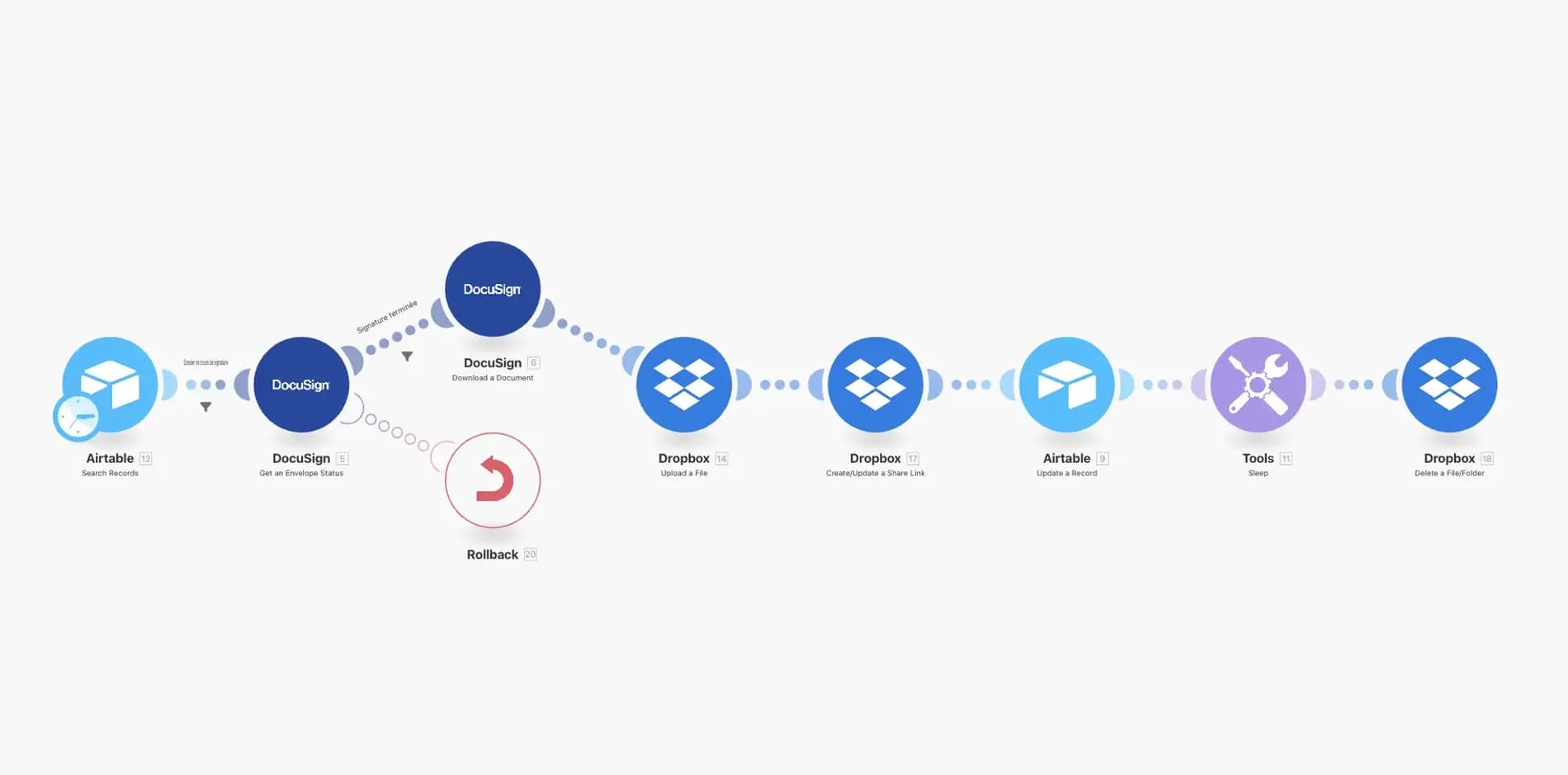
Automation example
Higher quality of service for the client
A custom business application also enhances the client-side experience. You can better track commitments, meet deadlines, provide real-time updates, and share progress reports from a dedicated platform.
The client sees that your organization is clear, that information is consistent, and that their case is being followed. This builds trust and loyalty without adding manual work.
Centralized data and faster decision-making
A good business application becomes the backbone of your internal information system. It centralizes strategic data, eliminating multiple versions and conflicting tracking sheets.
With centralized data, executives and managers have reliable KPIs. They can make faster decisions on workload, priorities, hiring, investments, or commercial choices.
Competitive edge and scalability
Finally, a custom application creates a competitive advantage that’s hard to replicate. Your internal tools reflect your way of working and your industry expertise. It’s a digital asset others don’t have.
And most importantly, the solution can evolve. When your services change, when you add a new activity, or when new technologies emerge, the application can adapt. You’re no longer locked into rigid software.
How much does a custom business application cost?
Discussing budget without precise context would be dishonest. However, we can explain what really drives the cost of an internal application.
The factors that influence the budget
The cost mainly depends on the combination of these elements:
- number of processes covered by the application
- functional and technical complexity
- number of users and different profiles
- integration needs with existing software
The broader the scope and the more complex the integrations, the higher the budget. Conversely, a well-targeted scope focused on a few key processes remains widely accessible to an SME.
Cost vs traditional software: think in total cost
Comparing only the cost of building the application to a software subscription can be misleading. You need to look at the total cost over several years.
Off-the-shelf software may sometimes seem cheaper, but workarounds, re-entries, errors, and lost time weigh heavily. A custom business application, on the other hand, aims to save time, reduce errors, and streamline operational activity.
How to quickly estimate your project budget
The best approach is often a short scoping workshop. Together, we define the scope, priority integrations, the number of users, and the desired level of automation.
Based on this, it becomes possible to estimate a consistent order of magnitude, then break the project into several phases to limit risk and progress step by step.
Common mistakes to avoid in a custom business application project
A good business application relies as much on human choices as on technical ones. Some mistakes recur often and come at a high cost.
Underestimating employee time
If end users are not involved, the tool will be poorly received. They know the tasks, the exceptions, and the real-world cases that can derail a project if ignored.
Involving them in design and validation takes a little time, but prevents deploying internal software that doesn’t reflect reality.
Trying to rebuild everything at once
A project that is too broad, too long, and tries to cover everything in one go often ends up stalling. It’s better to target a few high-stakes processes, validate a first version, then expand gradually.
This principle of a targeted initial version helps secure return on investment and adjust the software as you go.
Neglecting integration with existing tools
A standalone business application, without solid integration with the rest of your information system, quickly creates duplicates and frustrations. From the start, you need to consider data exchanges with accounting, CRM, invoicing, messaging, or other platforms.
Integration is a technical issue, but above all, it’s a matter of designing information flows.
Not considering scalability and maintenance
Custom software must be able to evolve. If all the business logic depends on a single person or an exotic technology, you create a risky dependency.
From the start, you need to plan for a minimum of governance, documentation, and resources to keep the application alive over time.
How to choose the right partner to build your custom business application?
Even with the best solution idea, the outcome will depend on the partner supporting you in development and design.
Key criteria to check
A few points to verify before committing:
- experience with business application projects for SMEs and VSEs
- ability to understand your business and processes, not just the technical aspects
- mastery of low-code technologies and web integrations
- ability to provide support after launch for updates and maintenance
A good partner talks as much about processes, operational activities, and team members as they do about technologies and frameworks.
Summary checklist
Before launching the project, ensure you have clarity on at least these points:
- The processes you want to prioritize.
- The main users of the application.
- The tools the application needs to connect to.
- Your time and budget constraints.
- Your scalability expectations over the next two to three years.
- The role you expect from the partner after deployment.
What if your next growth phase relied on a custom business application?
In the end, a custom business application isn’t just a technical matter. It’s a tangible way to align your software, processes, data, and teams with the reality of your business. It’s also a sustainable differentiator, far harder to replicate than a simple commercial offering.
If you feel your current tools are slowing down your service, introducing errors, and costing you time, it’s probably the right moment to explore this type of solution with a partner who speaks as much business as they do technology. That’s exactly what we do at Scroll with the companies we support daily.
Ready to go further? Discover our custom business application service.
Frequently asked questions
How long does it take to build a custom business application?
Depending on the scope, it can range from a few weeks for a targeted low-code application to several months for a broader platform with many integrations. The key is to break the project into phases to deliver value quickly.
Can a custom business application scale with my company?
Yes, that’s one of its main advantages. As long as the architecture is well designed, you can add features, new user roles, or integrations as your projects evolve.
Can a custom business application be connected to our existing software?
In most cases, yes. Most modern software has APIs or data exchange mechanisms. The real question is identifying which information needs to flow, in which direction, and how often.
What’s the difference between a custom business application and an ERP?
An ERP is a broad software suite designed to cover many standard business functions. A custom business application, on the other hand, is tailored to your specific processes, with targeted but highly adapted coverage.
Can a small business afford this type of project?
Yes, provided the scope is realistic and priorities are well defined. With low-code and solid design, a small company can access highly effective internal tools without an excessive budget.