
Blog · Web development
MVP vs POC vs prototype: what to build first to avoid wasting 3 months?
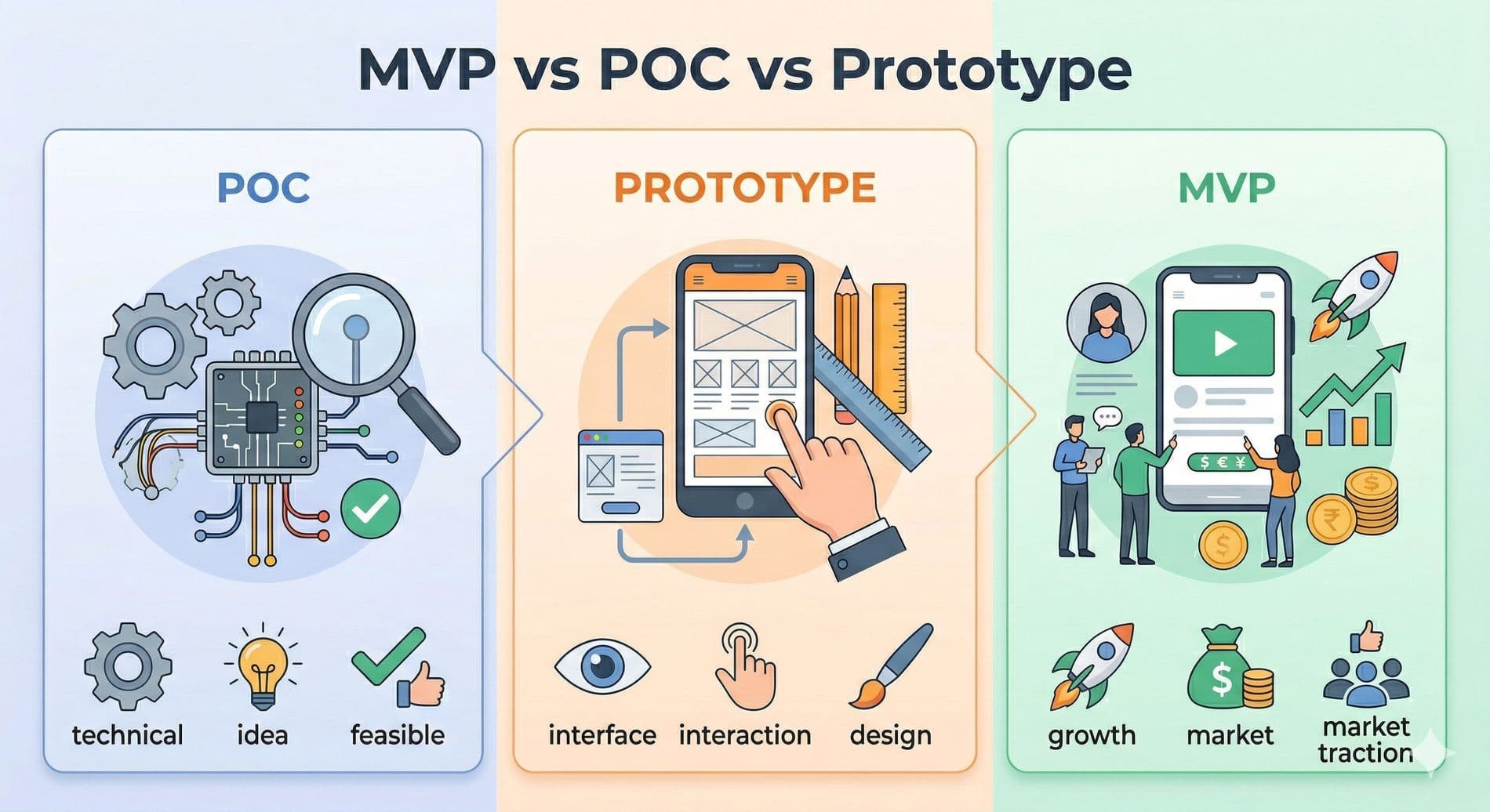
MVP vs POC vs prototype: compare the 3 formats, find out what to build first, and avoid a 3-month delay on your project.
When launching a digital product, the first mistake isn’t always technical. It’s often strategic. Many teams ask the wrong question. They ask: “What are we going to develop?” when they should first ask: “What do we need to validate right now?”
This is where the confusion between MVP, POC and prototype wastes a huge amount of time. These are three formats that serve different purposes, address different risks, and produce different types of learning. The result? Teams spend weeks building something impressive on paper but useless for deciding what comes next.
The most important thing to understand is simple. A POC validates technical feasibility. A prototype tests usability, user flow, and comprehension. An MVP confronts an offer with real users or a real market. Multiple French sources agree on this logic: a POC reduces technical risk, a prototype reduces usability risk, and an MVP reduces market risk.
In other words, these three formats aren’t competitors. They’re useful at different times. So the real question isn’t “which one is best,” but “which one should you build first in your case.”
The real problem: trying to validate everything at once
When a company has an idea for an internal tool, a SaaS, a customer app, or an AI-powered service, it often wants to move fast. That makes sense. But moving fast doesn’t mean skipping steps. It means choosing the right step.
Let’s take a classic example. An SME wants to launch a tool that centralizes customer requests, automates part of the processing, and adds an AI layer for sorting or recommendations. If the team decides to develop a full product from the start, they’re actually mixing three questions:
Can the tech work smoothly?
Will the interface be clear for users?
Are customers ready to use it, or even pay for it?
The issue is that these three questions require three different methods. A single delivery can’t properly address all three. This is precisely why POC, prototype, and MVP approaches exist. They allow you to separate risks rather than stacking them.
When you don’t make this distinction, you end up building a fake MVP that isn’t one at all. Often, it’s just an overdeveloped prototype. Or a POC disguised as a product. And that’s when you lose two to three months.
Proof of concept definition: what is a POC really for?
The proof of concept, or preuve de concept, is the right format when the main risk is technical. The question it answers is very simple: can this idea actually work in reality?
A POC isn’t meant to be beautiful. It isn’t meant to be marketable. It isn’t even meant to be truly usable. It’s there to test a critical point. This could be an ERP integration, the quality of a search engine, the reliability of an AI workflow, synchronization between multiple tools, document recognition, or processing speed on real-world data volumes. All sources describing POCs emphasize this function: proving the feasibility of a concept or technical constraint before investing further.
A good POC is therefore targeted. It tests a specific hypothesis. For example:
Your future product relies on automatic data extraction from complex PDFs. Before designing a full software solution, you should verify whether the extraction is reliable on your actual documents.
Your project depends on a generative AI connected to a business database. Before thinking about onboarding, billing, and user dashboards, you need to check if the responses are good enough to create value.
Your app needs a matching engine between profiles and needs. Before launching a public version, you must measure the quality of the matching.
In these cases, starting with a POC is the smartest choice. You avoid building an entire product layer on an uncertain foundation.
However, a POC doesn’t prove that the market wants your solution. Nor does it prove that the experience will be clear. That’s its limitation. It answers a technical question, not a business one.
Prototype application: when you need to test usage before coding
The prototype comes into play at a different stage. Here, the question is no longer “is it feasible?” but “is it understandable, smooth, and credible in use?”
An application prototypeis used to represent the product before its full development. It can take the form of a clickable mockup, a Figma journey, a sequence of screens, or sometimes a semi-functional demo. The goal is to test usability, screens, navigation logic, wording, the clarity of the value proposition, and the reactions of future users. Multiple sources clearly distinguish the prototype from the POC on this point: the prototype primarily helps refine the interface, usability, and user projection.
The prototype is particularly useful in four situations.
First, when the product involves many interactions. Back-office, dashboard, input tunnel, management tool, client interface, member area… In these cases, the quality of the user journey matters greatly.
Second, when you need to align decision-makers. A prototype demonstrates the project faster than a twenty-page specification document.
Third, when users struggle to clearly express their needs. Showing a screen often elicits better feedback than an abstract discussion.
Fourth, when you need to sell the project internally or secure a budget. A functional mockup helps make the idea tangible.
However, the prototype has one major limitation. It can create a false sense of security. Because it “looks” like a product, many teams believe they’ve validated something solid. In reality, they’ve mostly validated a perception. They know the journey seems relevant. They don’t yet know if the technology will hold up or if the market will respond.
What is an MVP, at its core?
The MVP, or minimum viable product, is arguably the most used and most misunderstood term. Many assume an MVP is just a “light version” of the final product. That’s not precise enough.
The true purpose of an MVP is this: to release a minimal yet genuinely usable version to the market in order to learn from real users. Recent sources cited earlier present it as a market validation tool, not merely an incomplete version of a product.
An MVP answers very concrete questions:
Do users understand the promise?
Do they come back?
Do they perform the expected action?
Are they willing to pay, book, request a demo, or change their habits?
That’s why an MVP must be functional, even if limited. It doesn’t need to do everything. It needs to do a few things well, addressing a core problem.
Let’s take a simple example. You want to launch a SaaS management tool for construction tradespeople. A bad MVP would try to include quotes, scheduling, messaging, follow-ups, e-signatures, CRM, and reporting in version 1. A good MVP isolates the main pain point—say, client follow-ups after a quote—and builds a minimal version that truly solves it.
It’s counterintuitive, but a good MVP vs POC vs prototype stands out precisely by its level of real commitment. The MVP exposes your project to the market. And that’s why it’s so valuable.
So, what should you build first?
The right answer depends on the dominant risk.
If your idea relies on uncertain technology, start with a POC.
If your technology is clear but the user journey is still unclear, start with a prototype.
If you already know what to build and the real uncertainty is market appetite, start with an MVP.
In other words:
The POC validates technical feasibility.
The prototype validates usability.
The MVP validates potential traction.
This sequence is now adopted by many product and development players: you move faster when you address one type of risk at a time, rather than hoping a single deliverable will answer everything.
The right order in real life
In many digital projects, the most logical order looks like this:
First, a POC—but only if there’s a real technical uncertainty.
Then, a prototype to finalize the useful scope, the user journey, and the screens.
Finally, an MVP to measure a real market response.
But let’s be honest: not every project needs all three. In fact, this is often where you save time.
A fairly simple internal tool, with no technical challenges, can go straight from scoping to prototype and then to MVP.
An ambitious AI product may require a serious POC before any mockup.
A digitized service offering can sometimes go almost straight to a very lightweight MVP, especially if the use case is already known and the main challenge is conversion.
The real skill, therefore, isn’t following a fixed recipe. It’s choosing the step that reduces the most risk right now.
Why do so many teams waste 3 months?
Because they overbuild too early.
They develop secondary features before validating the core.
They confuse internal demos with market proof.
They think polished design equals product validation.
They ask tech to compensate for a vague scope.
In reality, the confusion between MVP vs. POC vs. prototype often leads to three types of waste.
The first is financial. You invest in a scope that’s too broad.
The second is organizational. The team spends too long debating details while the real hypothesis remains untested.
The third is commercial. You delay real-world confrontation.
The most frustrating part is that these losses don’t come from a lack of effort. They come from poor decision-making order.
A simple method to decide
Here’s a very simple framework.
If your main fear is: “What if the tech doesn’t work?”, build a POC.
If your main fear is: “What if users don’t understand it?”, build a prototype.
If your main fear is: “What if no one actually wants it?”, build an MVP.
This method seems basic, but it changes everything. It forces you to name the primary risk. And until that risk is clear, you don’t have the right format yet.
Another useful point: the deliverable isn’t the focus. The learning is. A successful POC isn’t clean code. It’s a clear answer on technical feasibility. A successful prototype isn’t a beautiful mockup. It’s a clear understanding of user journeys. A successful MVP isn’t a small product. It’s proof of interest, usage, or commercial potential.
What to remember before launching your project
If you're still hesitant between MVP vs POC vs prototype, don’t look for the most theoretical definition. Look at the risk you need to eliminate first.
A POC is used to determine if it can work.
A prototype is used to see how it should look.
An MVP is used to verify if it deserves to exist in the market.
This logic is what prevents wasting three months. Not a miracle method. Not another framework. Just the right level of validation at the right time.
And above all, don’t forget this: building less at the start doesn’t mean aiming small. It means aiming right. The projects that move the fastest aren’t the ones that develop the earliest. They’re the ones that reduce the right uncertainties in the right order. The distinctions between POC, prototype, and MVP are precisely made for that.
To go from idea to the right deliverable
When you’re deep in your project, it’s easy to head in the wrong direction. You want to reassure everyone, show something tangible, move fast, and not miss the timing. That’s exactly why external framing is often useful.
At Scroll, we help teams choose the right starting point: proof of concept, prototype application, minimum viable product or a lightweight combination of these approaches. The goal isn’t to produce more deliverables. The goal is to find the shortest path between a promising idea and a useful validation. When this framing is right, the product moves faster, the budget is used more effectively, and decisions become much simpler.
Frequently asked questions
What is the difference between an MVP, a POC, and a prototype?
The difference between an MVP, a POC, and a prototype mainly lies in their purpose. A POC is used to validate the technical feasibility of an idea. A prototype helps visualize a product and test its usability before development. An MVP is a minimal functional version placed in the hands of real users to validate market interest.
Should you create a POC before an MVP?
Not always. You should create a POC before an MVP only if the project relies on a significant technical uncertainty. For example, if your product depends on complex automation, AI, or a sensitive integration, the POC helps confirm the solution is viable before investing in a full product.
When should you use a prototype in a digital project?
A prototype is useful when you need to clarify a user journey, test an interface, or concretely demonstrate how a future product will work. It is particularly relevant for a web application, SaaS, or business tool with multiple screens, as it helps validate the experience before development.
What is an MVP in an application development project?
An MVP, or minimum viable product, is the first functional version of an application designed to test a value proposition in the market. It includes only the essential features. The goal of an MVP is not to do everything, but to quickly launch a useful version to gather real user feedback.
What should you build first to validate a product idea?
To know what to build first, you need to identify the project’s main risk. If the uncertainty is technical, start with a POC. If the doubt concerns usability or comprehension, it’s better to create a prototype. If the real issue is whether the market will respond, the right choice is to launch an MVP.