Blog · AI
RAG or fine-tuning: which solution for a reliable enterprise AI?
RAG or fine-tuning: compare both approaches and discover which solution to choose to build a reliable enterprise AI.
When a company wants to deploy a useful AI internally, the same question quickly arises: should you choose RAG or fine-tuning?
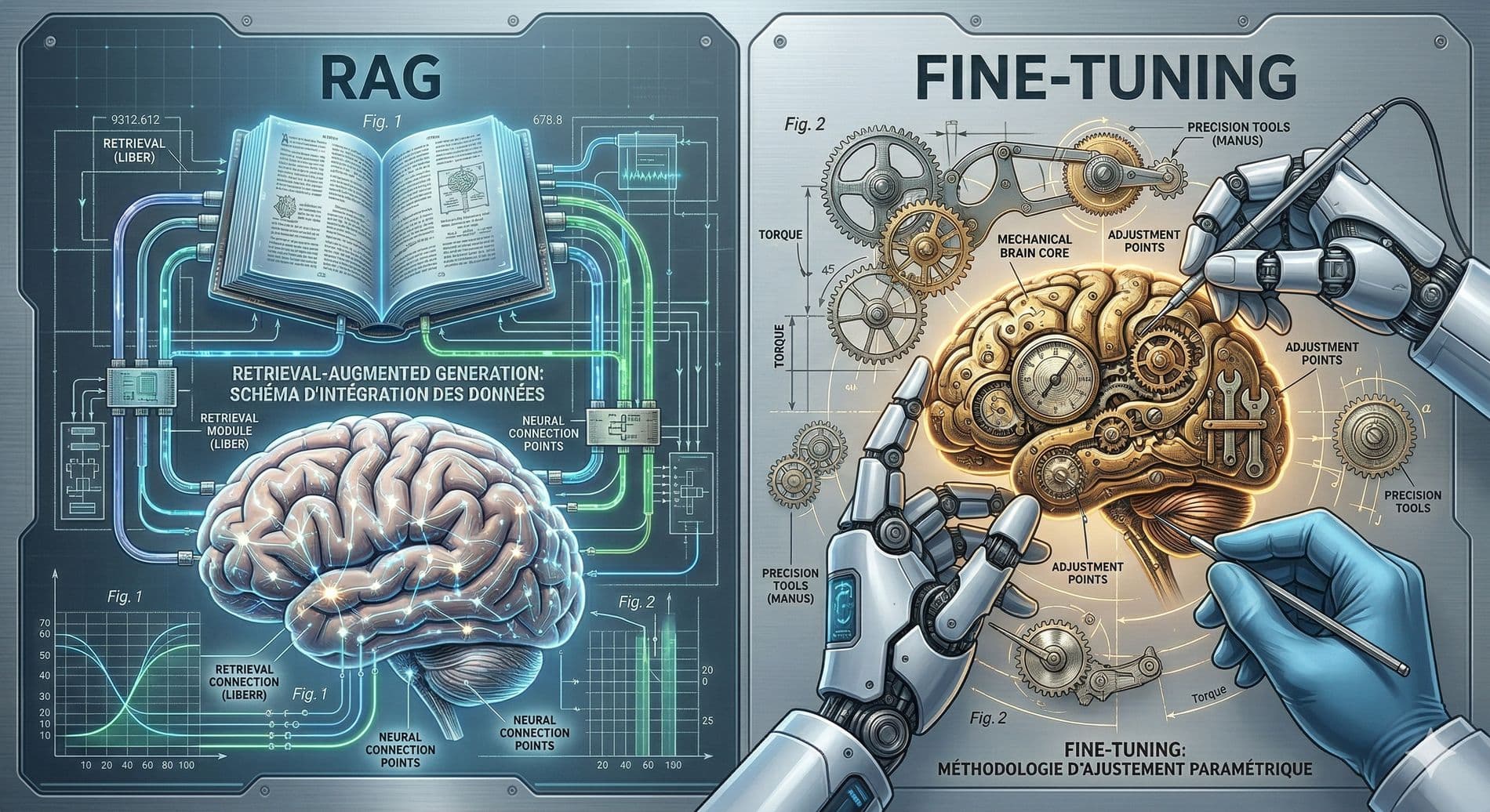
On paper, both approaches promise a more relevant enterprise AI. In practice, they address different needs. RAG enables a model to fetch information from an external knowledge base at the time of response. Fine-tuning, on the other hand, modifies the model’s behavior by adapting it to a specific dataset or task.
For an SME, a B2B SaaS, or a business team, the real question isn’t “which tech is the most advanced?”. The real question is simpler: which solution delivers a reliable, up-to-date, cost-effective, and actionable AI in a real-world context?
In this article, we’ll clarify the difference between RAG and fine-tuning, explore use cases where each approach makes sense, and above all, understand why the best answer for businesses is almost never purely theoretical.
Why this question comes up in almost every AI project
Since LLMs entered business tools, many companies want to create an internal AI assistant, a document search engine, an augmented customer support system, or a copilot for their teams.
The problem is that a general-purpose model already knows a lot, but it doesn’t know your company. It may not know your internal documentation, processes, offers, business rules, or the latest version of a commercial document or quality database. And that’s where the need for customization arises. An LLM can generate content. To become a true enterprise AI, it must also be framed, connected to the right data, and governed properly.
That’s why the RAG vs. fine-tuning comparison has become central. It touches on enterprise AI reliability, data security, production costs, and the speed at which the system can evolve.
What exactly is RAG?
RAG stands for Retrieval-Augmented Generation. In short, you keep a base model but give it access to external sources at the time of response. Before generating its answer, the system retrieves the most useful information from a corpus of documents, a vector database, internal documentation, a help center, or a knowledge base. Then, it constructs its response based on these elements.
This is a highly suitable approach for companies that want to connect an AI to dynamic content: contracts, procedures, product sheets, support documentation, meeting minutes, FAQs, HR databases, technical documentation, or sales databases.
In other words, RAG doesn’t try to teach all your data to the model. It mainly teaches it how to fetch the right data at the right time.
It’s often the first relevant enterprise AI architecture when you want to create a reliable AI assistant without starting from scratch.
What exactly is fine-tuning?
Fine-tuning involves taking a pre-trained model and adapting it to a more specific need. Here, you don’t just provide context at the time of response. You actually modify the model so it responds in a certain way, with a tone, format, behavior, or skill better aligned with the intended task.
This is useful when the real need is less about accessing up-to-date information and more about the model’s behavior itself.
For example, a company might want a model that:
always responds in a precise structure,
classifies requests according to a business taxonomy,
rephrase with a consistent language level,
generates outputs in a strict format,
or performs a specialized task better than a generalist model.
AI fine-tuning is therefore a logic of deep customization. It’s not just about connecting the model to company data. The goal is to make it better at a specific task.
RAG or fine-tuning: the difference that really matters
The difference between RAG and fine-tuning can be summed up simply.
With RAG, you improve access to knowledge.
With fine-tuning, you improve the model’s behavior.
This is the most useful distinction for a decision-maker.
If your problem is: “our AI must respond with the right, up-to-date information from our internal documents,” you’re often dealing with a RAG use case.
If your problem is: “our AI must learn a specific way to respond, classify, write, or structure,” you’re leaning toward fine-tuning.
AWS and Microsoft sources align with this: RAG is suited for retrieving business information and quickly integrating recent documents, while fine-tuning becomes useful when you want to permanently change the model’s behavior.
Why RAG appeals so much to businesses
Enterprise RAG ticks several very concrete boxes.
First, it allows working with company data that changes frequently. A document base, a catalog, a quality procedure, or a support database can evolve without requiring the model to be retrained with each update. AWS notes that RAG can quickly integrate new documents without fine-tuning.
Second, it helps better govern responses. When AI relies on identified sources, it becomes easier to trace what it used, limit the scope of answers, and reduce certain AI hallucination risks. Reducing is not eliminating. A poorly designed RAG system can still make mistakes, retrieve the wrong document, or misinterpret a source. But in an enterprise context, it provides a much higher level of control than a simple prompt connected to a generic LLM.
Finally, RAG costs are often easier to frame at the start than full fine-tuning. You mainly invest in data preparation, indexing, vector databases, retrieval rules, and orchestration. It’s already a significant project, but it’s often faster to launch for a first internal AI assistant.
Why fine-tuning still has a real place
Fine-tuning hasn’t disappeared with the rise of RAG. It’s simply more relevant in other situations.
It becomes interesting when you want strong consistency in a type of output. For example, in business workflows where the expected format is strict, or in tasks like classification, structured extraction, moderation, specialized analysis, or highly controlled generation.
Microsoft highlights a key point: prompts and RAG can provide context, but they don’t fundamentally change the model’s behavior. If your goal is to consistently align this behavior, fine-tuning makes sense.
Fine-tuning AI can also be useful when a company has a sufficient volume of high-quality, well-annotated examples and a stable enough use case to justify the investment.
However, many teams overestimate its value too early. They want to “train their AI on their documents,” when their real need is simply to make those documents properly searchable via a RAG system. This is a common mistake in enterprise AI projects.
The most common misstep: wanting to fine-tune to inject knowledge
This is often where projects get complicated.
A company might think: “We have a lot of internal documents, so we’ll fine-tune the model on them.” In reality, this isn’t always the right approach. If the content changes, if business knowledge evolves, or if the documents are numerous and heterogeneous, fine-tuning quickly becomes difficult to maintain.
RAG was popularized precisely for this reason: it allows answers to be grounded in external, updatable sources, rather than trying to embed all knowledge within the model’s weights. IBM and AWS clearly present this logic.
In the real world of an SME, this is often the right first step.
Which AI solution for businesses, depending on the use case?
The right approach depends less on the buzzword and more on the business problem.
Let’s look at a few concrete scenarios.
A support team wants an assistant capable of answering questions based on a knowledge base, technical articles, and internal procedures. In this case, enterprise RAG is often the best choice. The primary need is access to reliable, up-to-date information.
A sales team wants an assistant to help rephrase proposals, summarize meetings, and quickly retrieve arguments from internal documents. Again, RAG often has the edge—provided the content is well-structured.
A business team wants an engine that automatically classifies files according to a very specific logic, with outputs in a predefined format. Here, fine-tuning can become relevant, especially if there’s a history of validated examples.
A SaaS product wants to embed an AI that adopts a consistent tone, structure, and responses within a limited scope. In this case, a hybrid approach may be the best option: RAG for fresh knowledge, fine-tuning for behavior.
This is, in fact, the reality of many serious projects. RAG vs. fine-tuning is often framed as a binary choice, but in practice, the two can complement each other.
And what about reliability in all of this?
This is the core of the issue.
A reliable enterprise AI isn’t just one that “responds well.” It’s an AI that responds accurately, within the right scope, with an appropriate confidence level, based on controlled sources, and with consistent behavior over time.
RAG improves reliability when the main problem is access to the right information. It can also make responses more auditable if the architecture includes the right sources, proper document segmentation, and the right safeguards. But a poorly configured RAG connected to messy data will produce messy answers.
Fine-tuning improves reliability when the main problem is behavioral consistency. It can make the model more disciplined for a given task. However, it doesn’t replace a clean data strategy or clear governance of sources.
In other words, enterprise AI reliability doesn’t depend solely on choosing between RAG or fine-tuning. It also depends on document quality, architecture, conversational design, access rights, monitoring, and business testing.
That’s why a well-executed AI project rarely looks like a simple model integration. It’s more like a product project.
The often-underestimated topic: data quality
Many projects fail here.
We spend weeks debating the best enterprise LLM, the cost of RAG, or the cost of fine-tuning, when the real weakness lies in the company’s data. Outdated documents, duplicates, wrong versions, contradictory information, lack of structure, poorly managed access rights.
An internal AI assistant doesn’t become reliable by magic. It reflects the clarity of your information system.
That’s also why the most effective projects don’t always start with the tech. They begin with framing the use case, defining sources of truth, user roles, and the acceptable level of risk.
RAG cost vs. fine-tuning cost: what really matters
The pricing debate is often misframed.
The cost of RAG isn’t just about the model. You also need to account for content preparation, indexing, vector databases, orchestration, security, testing, and maintaining the document pipeline.
The cost of fine-tuning isn’t just about training. It also includes collecting and ensuring the quality of examples, data cleaning, iterations, evaluation, deployment, and sometimes redoing cycles when business context changes.
In many cases, RAG is faster to monetize for a company looking to connect AI to its business knowledge. AWS highlights this for document-based Q&A systems with custom content.
But beware of the shortcut “RAG = always cheaper.” At scale, a poorly designed RAG architecture can also be expensive in tokens, latency, and maintenance. The right choice depends on usage volume, document complexity, and business requirements.
AI data security: the criterion that often changes the decision
As soon as we talk about enterprise AI, data security becomes a decisive factor.
Who can query what? Which documents are accessible? Does the assistant respect access rights? Can responses be siloed by team? Are sources properly hosted? Are logs controlled?
Again, the choice between RAG and fine-tuning isn’t enough. A secure project depends above all on the overall architecture.
RAG requires real discipline in sources, permissions, indexing, and context retrieval. Fine-tuning raises other questions, particularly about the data used for model adaptation and its governance.
For an SME, the right level of security isn’t necessarily the same as for a banking group. But it must be considered from the start. Otherwise, the tool is quickly blocked by IT, legal teams, or simply the fear of doing it wrong.
The best choice for an SME today
In most of the enterprise AI projects we see emerging, the best starting point isn’t fine-tuning. It’s often a well-designed RAG, framed around a specific use case, connected to clean sources, with clear business rules and real user testing. AWS recommendations and IBM definitions align with this for business knowledge needs and evolving documents.
Why? Because most companies first want an AI that can retrieve the right information before they want an AI with ultra-personalized behavior.
Fine-tuning becomes highly valuable later, when the need is more mature, stable, well-instrumented, and when there’s enough high-quality data to justify this additional layer.
In short:
if you’re looking for an AI connected to your business content, think RAG first;
if you’re looking for an AI that needs to learn a specific way of responding or executing a task, consider fine-tuning;
if your project becomes strategic, prepare for a hybrid architecture.
What many companies should do before deciding
Before choosing an enterprise AI architecture, you need to answer a few simple questions.
Is the need about knowledge or behavior?
Does the content change frequently?
Are the documents clean, usable, and structured?
Does the AI need to cite its sources, respect access rights, or stay within a very closed business scope?
Do we have high-quality examples to train or adapt a model?
What is the real cost of an incorrect answer?
At this stage, the question is no longer “RAG or fine-tuning” in a theoretical sense. The question becomes “which enterprise AI solution fits our real-world context?”
And that’s exactly where a serious framework saves time, budget, and a lot of unnecessary back-and-forth.
The right approach for reliable and useful AI
RAG or fine-tuning? The right answer is rarely ideological.
RAG is often the best starting point for enterprise AI that needs to access up-to-date business data, reduce AI hallucinations, and remain usable without a heavy retraining cycle. Fine-tuning becomes valuable when you need to finely shape behavior, response structure, or performance on a very specific task.
Ultimately, the most important thing isn’t choosing the trendy term. It’s building an AI architecture that stands the test of time, respects business constraints, and delivers real value to teams.
This is also where many projects are decided. Between a prototype that impresses in a demo and a reliable production solution, there’s all the work of framing, structuring, connecting to data, and implementation. At Scroll, this is precisely what we help with—AI projects, automations, and business apps designed to be useful, robust, and truly adopted.
Whichever you choose, we can build your enterprise RAG solution.
Frequently asked questions
What is the difference between RAG and fine-tuning?
RAG enables an AI to retrieve information from documents or knowledge bases in real time when answering. Fine-tuning involves adapting a model’s behavior for a specific task, tone, or format. In short, RAG improves access to enterprise data, while fine-tuning improves how the AI responds.
Is RAG or fine-tuning more reliable for enterprise AI?
It depends on the need. For enterprise AI that must answer based on internal documents, RAG is often more reliable, as it relies on up-to-date sources. Fine-tuning becomes relevant when the goal is to achieve more stable, precise, or business-specific behavior.
When should an enterprise choose RAG?
RAG should be prioritized when a company wants to connect an AI to its internal documentation, knowledge base, customer support, or business procedures. It’s often the best option if enterprise data evolves regularly and response reliability depends on access to recent information.
When does fine-tuning become useful in an AI project?
Fine-tuning becomes useful when a company wants to customize a model for a specific task, such as classification, information extraction, writing in a strict format, or applying a particular tone. It is especially relevant when high-quality datasets and a well-defined use case are available.
Can RAG and fine-tuning be combined in the same enterprise AI?
Yes, it is possible to combine RAG and fine-tuning in a single AI architecture. RAG enables the use of up-to-date enterprise data, while fine-tuning improves the model’s behavior. This hybrid approach is often the most effective for building a reliable, useful, and business-aligned enterprise AI.