Blog · Web development
What is an MVP? Everything you need to know about the Minimum Viable Product
MVP (Minimum Viable Product) in 2026: definition, key components, how to develop it quickly with AI (Lovable, Bolt) and avoid the non-scalable prototype trap.
If you’ve ever dabbled in the world of entrepreneurship, product development or project management, the term MVP may already ring a bell. But what does it *exactly* mean? And why has it become such a critical step in the creation and launch of a product or a service ? Let’s break it all down for you!
MVP Definition
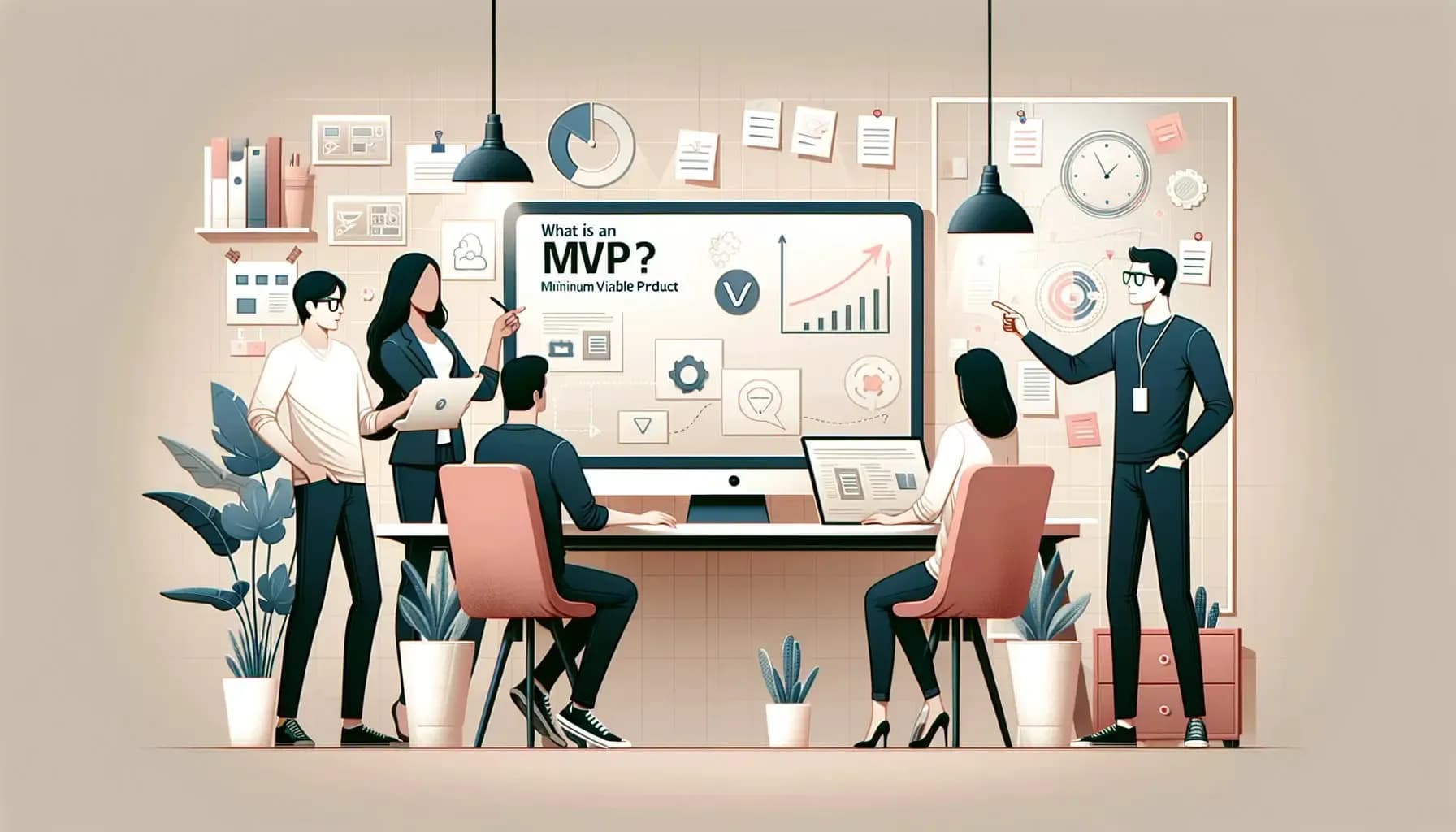
The MVP or Minimum Viable Product is a strategy that involves launching a simplified version of a product to the market, including only the essential features. The goal? Test your idea with real users as quickly as possible, while minimizing costs and effort. It’s a pragmatic approach rooted in learning and adaptation. You launch, observe, learn, and improve.
An MVP isn’t an end in itself—it’s a starting point, a springboard toward the ultimate version of your product. It’s the result of a careful balance between what’s economically viable, what’s desirable from the user’s perspective, and what’s technically feasible.
Why Choose an MVP?
So, why start with an MVP? First, it lets you test the viability of your idea without pouring in astronomical sums. It gives you the chance to face the market, understand real user expectations, and adjust your approach accordingly.
Choosing an MVP also means embracing a humble and open mindset. It’s about accepting that you don’t have all the answers upfront and being ready to learn from your users. It’s about prioritizing flexibility and speed over perfection.
The concept of MVP traces back to the era of agile and lean development—two methodologies that champion flexibility, adaptability, and efficiency. Over time, the MVP has become a near-mandatory step for any startup or innovative company looking to launch a new product.
Key Components of an MVP
Exploring the Minimum Viable Product (MVP) concept means understanding its essential components. What are the crucial elements that make it up, and how do they ensure your product’s initial success?
Essential Features
Identifying Core Features
The first step in building a successful MVP is carefully identifying the essential features. This requires discernment to determine what’s absolutely necessary to deliver your product’s value proposition. No room for fluff here! Ask yourself: Which features are non-negotiable for the product to exist? These—and only these—should be included in your MVP.
Focus on User Value
Every selected feature must deliver tangible value to the user. An MVP must be user-centric, addressing their needs precisely and effectively. User value is the compass guiding every decision. Ask yourself: How will this feature help the user? How will it improve their daily life or solve their problem?
Examples of MVP Features Across Industries
Let’s look at some concrete examples. In e-commerce, an MVP might focus on simplified navigation, a streamlined checkout process, and a secure payment system. For a professional networking app, the emphasis would be on profile creation, user search, and instant messaging.
Design and User Experience
The Importance of Clean, Functional Design
Design plays a pivotal role in an MVP’s success. Clean, functional design isn’t just visually appealing—it enhances usability and contributes to a better user experience. Design should serve functionality, not the other way around. Every visual element, every interaction should have a clear purpose and support the user’s goals.
The Role of User Experience in MVP Success
User experience (UX) is the heartbeat of your MVP. A well-executed UX means users can achieve their goals with ease, efficiency, and satisfaction. An MVP with great UX is one that truly understands its users’ needs and expectations—and addresses them in the most intuitive way possible.
Tips for Optimizing UX/UI in an MVP
How can you optimize the UX/UI in your MVP? Start by listening to your users. Conduct user testing, gather feedback, and observe how they interact with your product. Pay attention to their needs and frustrations. Simplify user journeys, minimize the number of clicks required to complete a task. And above all, stay open to change. An MVP’s UX/UI is never set in stone—it evolves based on learnings and user feedback.
How to Develop an MVP?
Developing a Minimum Viable Product (MVP) is an exciting journey—a process that demands rigor, agility, and a healthy dose of creativity. Let’s explore the critical steps and resources needed to turn your idea into a tangible, high-performing product.
Development Steps
Planning and Defining Goals
It all starts with meticulous planning. What are your MVP’s goals? What are you trying to test or validate? Take the time to clearly define your expectations, understand your users’ needs, and outline your project’s scope. This is the foundation on which everything else will be built.
Choosing Technologies and Tools
Selecting the right technologies and tools is a decisive step. You need to strike a balance between performance, cost, and ease of use. Among the available options, Bubble stands out as a particularly well-suited solution for MVP development. This no-code development platform lets you build robust, scalable web applications without any coding expertise. Bubble offers great flexibility, allowing you to quickly test ideas and make on-the-fly adjustments—ideal for an MVP.
Agile and Iterative Development
Adopting an agile and iterative approach is key to MVP development. It’s about progressing in small steps, building your product feature by feature while staying open to adjustments along the way. This method fosters responsiveness and adaptability—two essential qualities when working on an MVP.
Testing and Validation
Testing and validation are the moment of truth for your MVP. Every feature, every design aspect must be put to the test. Gather user feedback, measure performance, identify friction points, and adjust accordingly. These testing phases are crucial to ensure your product meets expectations and is market-ready.
Resources and Required Skills
Key Profiles and Roles in the Development Team
To successfully develop an MVP, you need a strong, skilled team. You’ll require a variety of roles: designers for UX/UI, developers, a project manager to ensure coordination, and analysts to evaluate performance and user feedback.
Recommended Tools and Platforms
Beyond Bubble for development, other tools can prove invaluable. Consider alternatives like Flutterflow, project management platforms like Trello or Notion, Google Analytics for data analysis, or Figma for design.
Budget and Financial Planning
Finally, don’t forget to plan your budget carefully. While an MVP aims to minimize costs, it still requires investment. Anticipate expenses related to tools, human resources, and various testing phases. Rigorous financial planning is the key to avoiding unpleasant surprises and ensuring your project’s viability.
Creating an MVP with AI in 2026: Lovable, Bolt, and Their Limitations
In 2026, the fastest way to launch an MVP is no longer visual no-code or traditional development—it’s AI-generation. With Lovable, Bolt.new or v0, a non-technical founder can produce a functional MVP (auth, database, UI) in a single day from a prompt.
This is great news for the validation phase: you can test your value proposition with real users without raising funds or hiring a CTO. But beware of the classic trap: an AI-generated MVP is not a production-ready application. As soon as the product gains traction, limitations emerge (security, scalability, technical debt).
The winning strategy in 2026: validate with an AI-generated MVP, then secure and rebuild on a maintainable stack once product-market fit is confirmed. This is exactly the kind of transition we handle at Scroll—see the AI project recovery offer and our Lovable Jailbreak guide.
Develop Your MVP Fast with Scroll Agency
At Scroll, we’ve mastered the art of turning your ideas into impactful, functional MVPs, aligned with your vision and needs. Looking to quickly launch a Minimum Viable Product to test your market? Our specialized MVP team will guide you every step of the way to bring your vision to life. Experts in agile development and user-centered design, we’re the ideal partner to support you. If the MVP journey appeals to you, it’s time to book a call with our experts. Contact us now and let’s discuss your project!