Blog · Automation
The benefits of automation: why automate tasks?

Why automate your tasks in 2026: real ROI in the era of AI agents + MCP, concrete examples, and the processes that finally justify the investment.
A few years ago, automation was seen as a threat to jobs. Today, it’s viewed as a solution that can help businesses. What does process automation actually involve? And what are the benefits of automating? We explain everything!
What is automation? What does it involve?
Technically, automation is the process of performing tasks with computers rather than people. More simply, it’s when you program a computer using automation tools to automatically perform a task that would normally be done by a human. This can include repetitive tasks, like data entry into a database, or tasks that require complex calculations, and more.
When can you automate your processes?
Automation can be used in all types of businesses to handle repetitive and tedious tasks, such as data entry, report compilation, or inventory tracking. It can also be used for more complex tasks, like resource planning or marketing campaign management.
The benefits of automation
The benefits of process automation are numerous. In addition to improving productivity and reducing costs, it also helps minimize errors and oversights. Furthermore, it can streamline data and process tracking, which is especially useful for dynamic businesses.
Benefit #1 of automation: Save time
Automation is a great way to save time. By automating repetitive and tedious tasks, you free up time to focus on the tasks that truly matter and require more of your attention.
Benefit #2 of automation: Reduce human errors
Automation can help reduce human errors. By automating tasks, processes, and workflows, outcomes become more accurate, and human errors can be eliminated or at least minimized. This allows businesses to operate more efficiently.
Benefit #3 of automation: Improve productivity
Automation is a powerful tool that can significantly boost business productivity. By automating certain tasks, companies can focus on more important tasks that require special attention. Additionally, automation can help reduce delays, which increases overall productivity.
Benefit #4 of automation: Improve communication
For example, automating administrative tasks is an excellent way to improve communication within businesses. Automation tools can help companies manage emails, appointments, and phone calls. They can also assist in organizing information and storing it centrally. By automating communication processes, businesses can ensure that information is always up to date and that communication channels are used effectively. Finally, automation tools can also help companies send follow-up emails, organize marketing campaigns, and handle complaints.
Benefit #5 of automation: Improve data tracking
Automating data tracking is essential for improving data accuracy and team productivity. By automating data tracking, you can ensure data is collected consistently and that teams have the latest real-time information. Additionally, automating data tracking allows teams to focus on other critical tasks, such as data analysis and decision-making.
Benefit #6 of automation: Reduce costs
Finally, thanks to all these benefits, process automation can help businesses significantly reduce their costs. By automating repetitive and tedious tasks, companies can free up valuable time and resources that can be better used elsewhere. Additionally, process automation enables businesses to better track and manage their operations, which can lead to productivity gains and substantial savings.
Automation in the AI era: What’s changing in 2026
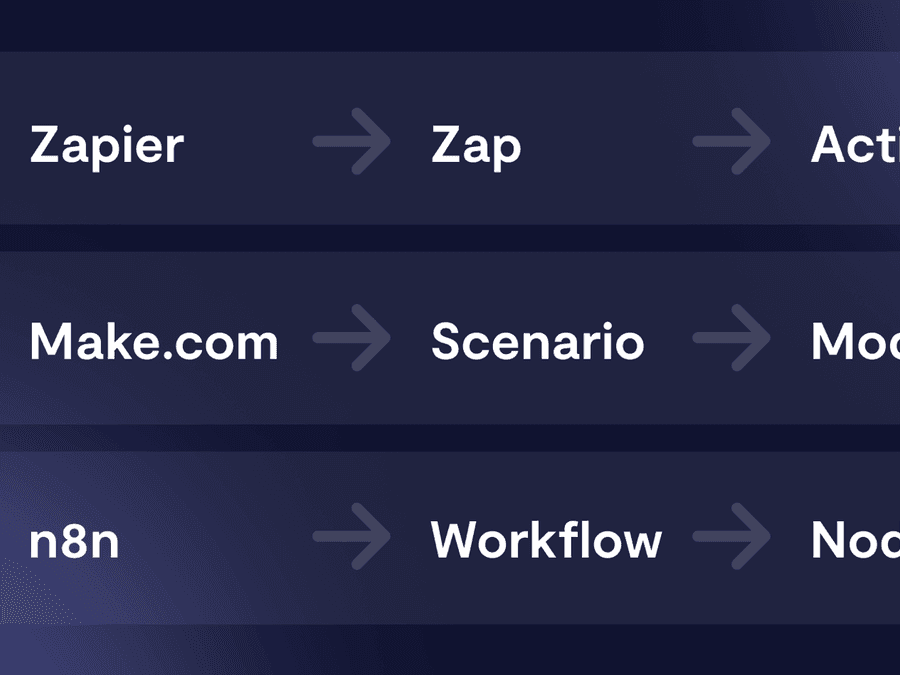
Until 2023, automating a task meant building a step-by-step workflow in Make, Zapier, or n8n. Today, AI agents (Claude, GPT-4o, Gemini) integrated into these tools via the MCP (Model Context Protocol) protocol allow delegating the decision itself: the agent receives a goal, chooses the steps, and adjusts along the way.
In concrete terms, three major changes:
- Hybrid workflows : a classic Make or n8n calls on Claude to qualify a lead, summarize an email, or extract data from a PDF—anything that previously required human interpretation.
- MCP servers : Claude directly accesses Notion, Linear, your CRM, or Supabase without intermediaries—automation becomes conversational.
- Plummeting costs : a Make + Claude workflow that would have cost €500 in development in 2023 can now be set up in an afternoon in 2026, with a negligible recurring cost (€0.01–0.10 per execution).
The ROI of automation has thus skyrocketed: what was profitable at 100 executions/month is now profitable at 10. If you dismissed an automation project due to complexity or cost in 2023, now is the time to reassess it.
Scroll supports you in your automation projects
Do you want to automate repetitive tasks in your business? At Scroll, our automation experts have enabled us to create the Make agency, a specialized service to meet your various process automation needs. To provide ultra-high-quality solutions, in addition to mastering Make, we also work with other no-code tools like Bubble, Airtable, or Webflow. Our experts develop tailored solutions for you and with you that perfectly meet your expectations. Feel free to contact us to discuss your project!