Blog · AI
MCP (Model Context Protocol): The Complete 2026 Guide to Connecting Claude to Your Tools
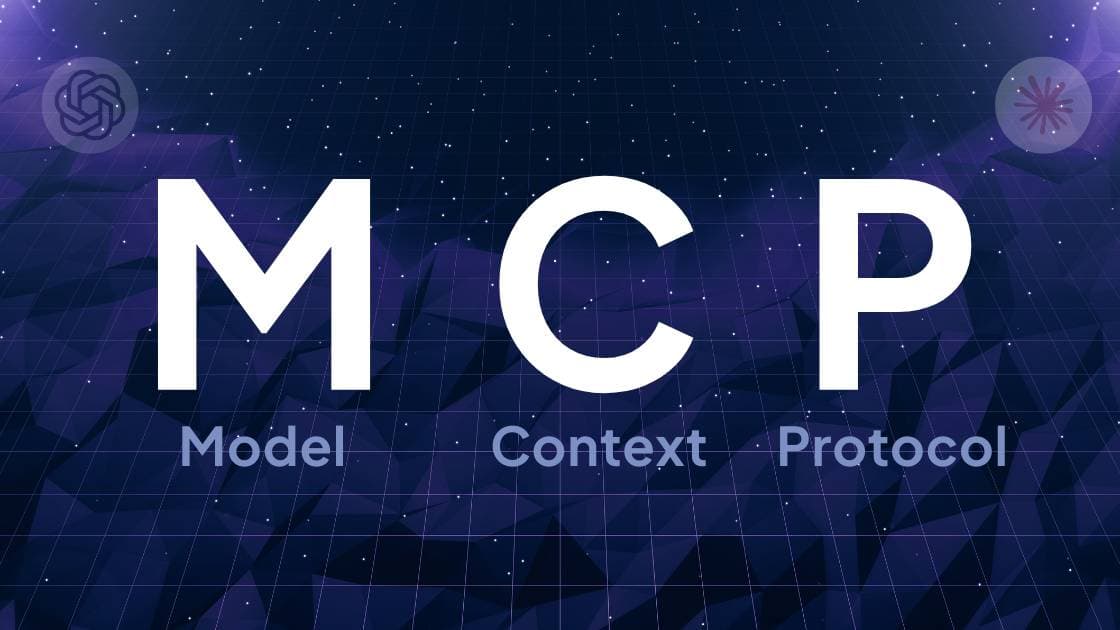
MCP (Model Context Protocol) in 2026: Architecture, Essential Servers (Supabase, n8n, Figma, Webflow, Cursor), Installation, and Security. Complete Scroll Guide.
MCP (Model Context Protocol) is the open standard launched by Anthropic in late 2024 that enables an AI model like Claude to directly access your tools—databases, CRM, task managers, Figma, Webflow—without requiring a custom integration each time. In practice: you install an MCP "server" for each tool, Claude connects to it, and you interact with it naturally while it reads, writes, and orchestrates. In 2026, the official registry lists over 9,400 available servers, and the protocol is supported by OpenAI, Google, and most major IDEs.
If you used AI in 2023–2024, you likely copy-pasted context into ChatGPT, exported a CSV, and manually reworked it. MCP eliminates that friction. This guide explains what MCP is, its real-world use cases, how to install it, and the security pitfalls to avoid. By the end, you’ll know whether MCP belongs in your stack and which server to start with.
MCP in 2 Minutes: The Definition That Works
MCP, short for Model Context Protocol, is a communication protocol between a language model (the "client": Claude Desktop, Cursor, Claude Code, etc.) and an external tool (the "MCP server": Notion, Linear, Supabase, Webflow, etc.). The server exposes a list of available actions—"read a file," "create an issue," "query the DB"—and the client uses these actions on the user’s request.
The most fitting analogy: if REST API is the USB of the internet, MCP is the USB for AI models. A Notion MCP server will work with Claude, but also with ChatGPT (which has supported MCP since March 2025) or any other compatible client. One integration, multiple AIs.
Three Technical Features to Remember:
What Is MCP Used for in Practice? 4 Concrete Use Cases
MCP isn’t a gimmick: it solves problems that cost hours in 2023.
1. Connect Claude to your database. With the Supabase MCP server, you can ask Claude "What are my 10 most recent sign-ups this month?" and it will query your PostgreSQL directly, respecting your RLS policies. No need to code a dedicated endpoint for every question. Details in our guide Supabase MCP: The Perfect Duo for Your Apps.
2. Orchestrate complex workflows via n8n. The n8n MCP allows Claude to trigger an existing automation workflow or create one on the fly. "When a Stripe lead comes in, qualify it, add it to Notion, and send a Slack to the team." The pattern is documented step-by-step in MCP n8n: The Ultimate Guide to Connecting Claude to Your Workflows.
3. Read and write in Figma or Webflow from your IDE. The Figma MCP server gives Cursor or Claude Code access to design files, enabling code generation aligned with components—not "code based on a screenshot." On the CMS side, the Webflow MCP allows reading/writing collections, pages, and assets. We cover this in Figma MCP: Connect Figma to Your API and Codebase and MCP Webflow: Connect Your Databases and Pages.
4. Connect AI to public data. The MCP data.gouv server exposes official French datasets to Claude—useful for business chatbots that need to answer with reliable public sources. The full guide is in MCP data.gouv: free guide for AI and public data.
MCP architecture: client, server, transport
To understand what you're installing, keep three roles in mind.
The MCP client is the application driving the conversation: Claude Desktop, ChatGPT Desktop, Cursor, Claude Code, or a custom agent you code. It interacts with the user (you) and the server (the tool).
The MCP server exposes a list of capabilities (tools, resources, prompts) that the client can invoke. A Notion server exposes “create a page,” “search the database,” etc. A Supabase server exposes “query table,” “execute SQL,” etc.
The transport is the communication channel: stdio if the server runs on your machine (most common in 2026), HTTP/SSE or WebSocket if the server is remote (useful for sharing a team stack).
In practice, you open your client (e.g., Claude Desktop), edit its configuration file to point to one or more MCP servers, and restart. Tools automatically appear in the interface. The client requests your permission before each sensitive action—this is critical for security (see below).
The MCP ecosystem in late 2026: where do we stand?
A few figures for context:
Three reliable sources to know for finding or publishing a server:
The most useful MCP servers in 2026
Here’s the selection that the Scroll team deploys most frequently for its clients in 2026.
For databases: Supabase MCP. Essential if you have a PostgreSQL backend. Read/write, controlled SQL execution, RLS compliance. Our practical guide.
For automation: n8n MCP. Enables Claude to orchestrate multi-step workflows. Production setup and patterns.
For design: Figma MCP. Cursor or Claude Code generate code aligned with actual Figma components. Connecting Figma to your codebase.
For CMS: Webflow MCP. Read/write access to collections, pages, and assets—useful for managing a team blog or catalog site. Overview.
For French public data: data.gouv MCP. Official source of truth, practical for business chatbots. User guide.
For the IDE: Cursor + Supabase MCP. Devs' favorite AI stack in 2026 — Cursor pilots the code, Supabase MCP provides access to real data. Our step-by-step setup.
Limitations and security considerations
MCP isn’t magic. Three pitfalls to keep in mind before deploying to production.
1. Permission security.A MCP server gives an AI model direct access to a tool. If the server is misconfigured, the AI could read data it shouldn’t, or worse, write or delete it. Always: restrict the scope (read-only where possible), run the server with a service account with minimal permissions, and enable client-side action confirmations for destructive operations.
2. The token cost.Each MCP action feeds context back to the model. In long conversations with many tools, token costs can skyrocket. Watch out for: the number of tools exposed simultaneously, response verbosity, and caching strategy (Claude 4 and beyond support native prompt caching—enable it).
3. The reliability of community servers. 9,400 servers is a lot. Not all are maintained, not all are secure. Before installing one: check the author, the number of GitHub stars, the date of the last commit, and read the code if possible. Official servers (published by the editors themselves) should be prioritized.
MCP vs alternatives: function calling, LangChain, proprietary agents
MCP isn’t alone in the market. Here’s how it stands in 2026.
The native function calling (OpenAI, Anthropic) already allows a model to call functions. MCP standardizes the layer above: you write the server once, and it works with all compatible clients. Without MCP, you have to rewrite the integration for each model/IDE.
The frameworks like LangChain or LlamaIndexare client-side libraries (Python/TS) for orchestrating multiple tools. MCP-compatible: you can use an MCP server as a tool in a LangChain chain. Complementary rather than opposing.
The proprietary agents from Salesforce, ServiceNow, etc. remain isolated in their ecosystems: useful if you're 100% Salesforce, limiting if your stack is heterogeneous.
Our recommendation at Scroll in 2026: default to MCP, especially if you have multiple tools to connect to multiple models. Pure function calling only if you have 1 model + 1 tool. Frameworks on top if your agent logic is complex (long-term memory, multi-step planning).
Integrating MCP into your stack: where to start
If you're new to MCP, here’s the order we recommend to avoid getting lost.
Step 1: install Claude Desktop or Cursor and enable a reference MCP server—such as filesystem (local file access) or brave-search (web search). Spend 1-2 days experimenting to get a feel for it.
Step 2: connect your most-used tool. Notion, Linear, Slack, Supabase, Webflow… pick the one where you spend the most time. The productivity gains are immediate.
Step 3: orchestrate. Combine 2-3 servers for cross-functional workflows (Stripe lead → enrichment → Notion → Slack). See our n8n+MCP guide for the automation part.
Step 4: build custom servers. Once you're comfortable, you can write your own MCP servers for internal tools (custom CRM, business database). The Python/TS SDK is very accessible: 50-100 lines are enough for a basic server.
MCP FAQ: the questions we get most often
See the FAQ section below for concise answers to the most frequent questions: MCP vs. API differences, security, costs, open-source alternatives, support for major models.
Launching an AI project with MCP: the Scroll approach
You’ve identified an MCP use case—connecting Claude to your CRM, automating onboarding, linking AI to your business database—but don’t know where to start? The Scroll team designs and deploys Claude + MCP stacks in production since 2024, from POC to enterprise. We audit your stack, select the relevant MCP servers (official or custom), secure permissions, and train your team on daily usage.
If you want to discuss this concretely, the Scroll diagnostic is free and delivered within 48 hours: we’ll tell you if MCP offers real ROI for your case, or if another approach (pure function calling, custom agent) would be more suitable.